For years, the direct mail industry has been laser-focused on efficiency.
You’ve cleansed your data, suppressed goneaways and deceased records, validated addresses, reduced undeliverable mail, and optimised postage. Every campaign is scrutinised to ensure that every item mailed has the best possible chance of being delivered, opened, and responded to.
In short, you’ve driven waste out of your mail production process.
But what happens when there is no more waste left to remove?
The Next Frontier: Operational Efficiency
Most organisations eventually reach a point where finding additional savings within production becomes increasingly difficult. The easy wins have already been delivered.
The conversation then needs to move beyond print, postage, and data quality and focus on the wider business operation.
Where else can costs be reduced?
Many businesses instinctively look at sales growth as the answer. More revenue is always welcome, but increasing sales often requires additional investment, additional resources, and additional risk.
Instead, it can be worth taking a fresh look at the biggest cost line on most profit and loss accounts:
People.
Before anyone misunderstands that statement, this isn’t about reducing salaries or expecting employees to work longer hours.
It’s about helping people work more efficiently.
Small Improvements Can Deliver Significant Results
Recently, we undertook an analysis which suggested that a relatively modest improvement in workforce efficiency could have a surprisingly large impact on profitability.
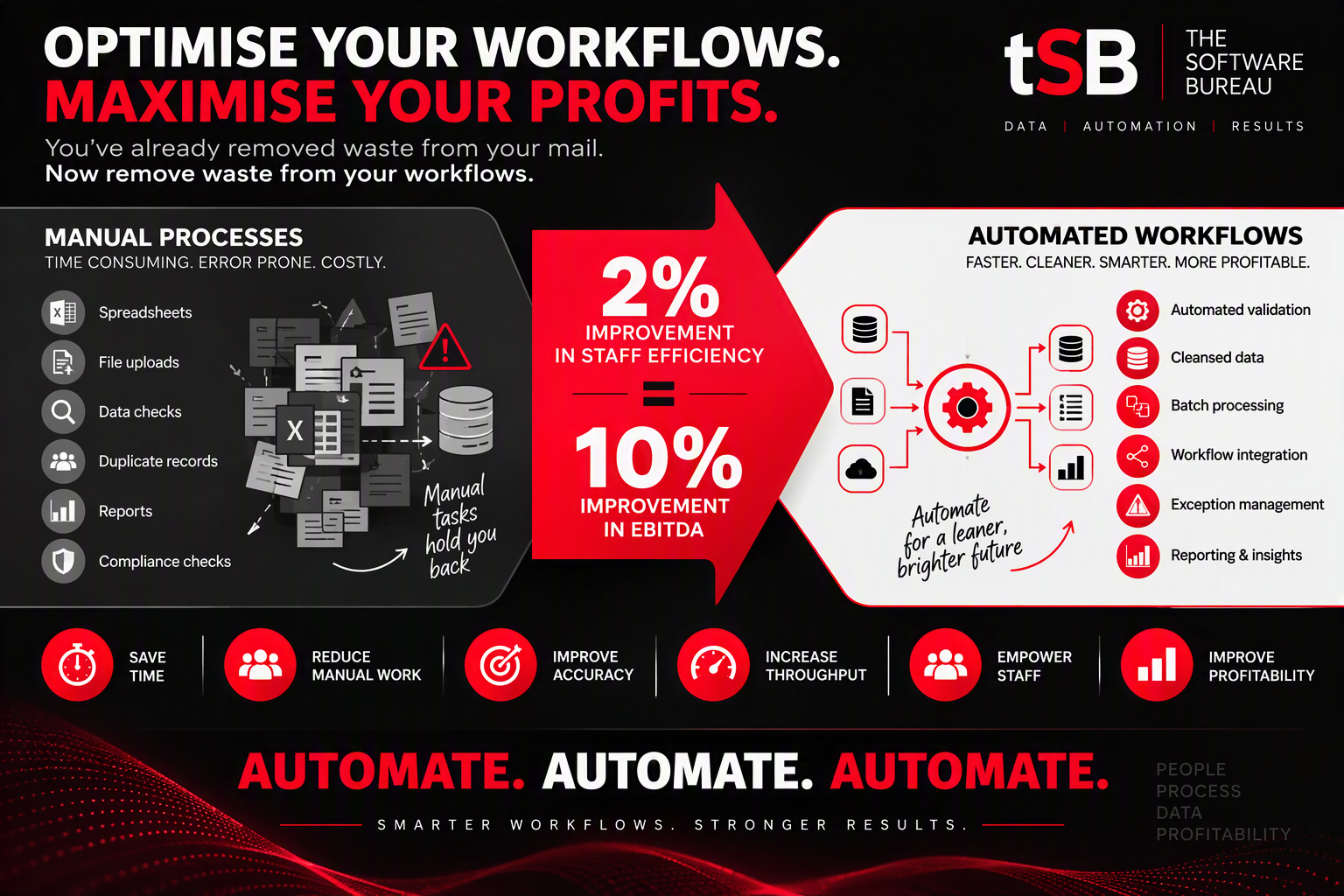
The findings indicated that improving staff efficiency by just 2% could potentially deliver a 10% improvement in EBITDA.
Take a mailing house turning over £8m, with 65 staff costing around £2.4m a year and EBITDA of £400k. Improve staff efficiency by just 2% and you free up almost £50k. That’s a 12% improvement in EBITDA.
The rule of thumb is simple: multiply your efficiency gain by your staff costs divided by your EBITDA. The thinner your margins, the bigger the effect.
And 2% is less than ten minutes per person per day, or about four and a half days per person per year.
Think about that for a moment.
A 2% improvement isn’t asking people to work harder. It’s about removing friction, eliminating repetitive tasks, reducing manual intervention, and helping employees spend more time on activities that genuinely add value.
Two percent is often hiding in plain sight.
It’s in the spreadsheets that are manually updated every day.
It’s in the repetitive data-processing tasks.
It’s in the copying and pasting between systems.
It’s in the manual checking of files and reports.
It’s in the workflow bottlenecks that everyone accepts because “that’s how we’ve always done it.”
Automation Isn’t About Replacing People
The word “automation” sometimes creates concern, but the reality is very different.
The best automation projects aren’t designed to replace people.
They’re designed to remove the boring bits.
Nobody joins an organisation because they enjoy manually moving files between folders, validating data one record at a time, or performing the same repetitive task hundreds of times every week.
Automation allows skilled employees to focus on the work that requires human judgement, creativity, problem-solving, and customer engagement.
The result is often a win for everyone:
- Employees spend less time on repetitive administration.
- Managers gain more visibility and control.
- Customers receive a faster and more consistent service.
- Businesses improve productivity and profitability.
Start with the Workflows
The most effective automation projects rarely begin with technology.
They begin by asking questions.
- Which tasks consume the most time?
- Where do errors regularly occur?
- Which processes rely on manual intervention?
- Where are staff spending time on activities that add little value?
- Which workflows slow down other parts of the business?
Once those areas are identified, automation can often deliver immediate and measurable benefits.
In many cases, organisations are surprised by how much of their day-to-day activity can be streamlined or automated safely.
Automation and Data Management Go Hand in Hand
For businesses that process large volumes of customer, prospect, or operational data, automation becomes even more valuable.
Data-driven workflows frequently involve:
- Importing and validating files
- Matching and deduplicating records
- Applying suppression checks
- Producing reports
- Exporting data to downstream systems
- Managing compliance and audit requirements
When these processes are automated, organisations not only reduce manual effort but also improve consistency, accuracy, and governance.
The Bottom Line
If you’ve already optimised your mail production process, the next opportunity may not be in the mail you send.
It may be in the way your organisation works.
A small increase in operational efficiency can have a disproportionate impact on profitability. The companies that continue to outperform are often those that look beyond traditional cost-saving measures and focus on removing friction from everyday business processes.
So here’s our top tip:
Automate. Automate. Automate.
You’ve already removed waste from your mail.
Now it’s time to remove waste from your workflows.