At The Software Bureau, quality is not something that is tested at the end of a project. It is built into every stage of our software development lifecycle. From initial design and development through to deployment and ongoing support, we are committed to delivering reliable, secure, and high-performing software solutions that our customers can depend on every day.
Our customers trust us with critical business processes, and we take that responsibility seriously. That is why we have invested heavily in automated quality assurance processes, specialist Quality Assurance resources, secure development practices, and independent security validation to ensure every release meets the highest standards.
Quality Built into Our Development Process
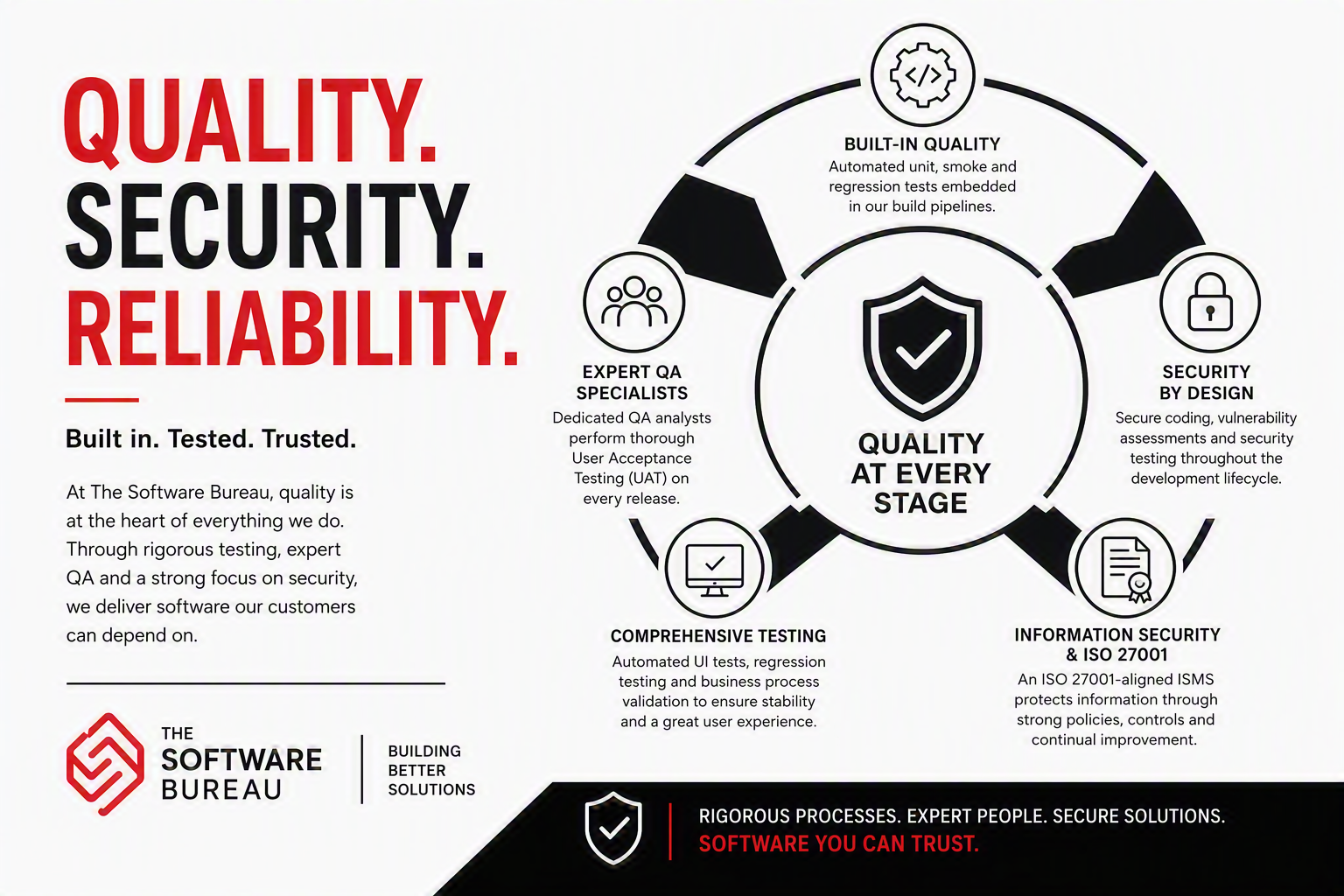
Modern software development demands a proactive approach to quality. Rather than relying solely on manual testing, we embed automated testing directly into our build and deployment pipelines.
Every code change passes through a comprehensive suite of quality checks designed to identify issues as early as possible in the development cycle. These include:
- Unit Testing to validate individual components and functions.
- Smoke Testing to confirm that critical functionality operates correctly after each build.
- Regression Testing to ensure that new changes do not adversely affect existing features.
- Automated User Interface (UI) Testing to verify a consistent user experience.
- Build Validation and Deployment Checks to ensure software is release-ready.
By integrating these tests into our continuous integration and delivery processes, we can identify defects early, reduce risk, and maintain a consistently high level of software quality.
Dedicated Quality Assurance Specialists
While automation delivers speed and consistency, exceptional software quality still requires human expertise and real-world validation.
The Software Bureau maintains a dedicated team of specialist Quality Assurance Analysts whose sole responsibility is to undertake thorough User Acceptance Testing (UAT) of all product upgrades, new features, and software releases.
This independent layer of testing ensures that software is assessed from the perspective of the end user, validating not only technical functionality but also business processes, usability, workflows, and practical operational scenarios.
Our QA specialists carefully evaluate:
- User workflows and business processes.
- Feature functionality and expected outcomes.
- User interface consistency and usability.
- Edge cases and uncommon scenarios.
- Regression impacts across existing functionality.
- Overall release readiness and customer experience.
This combination of automated and manual testing helps us identify issues that technology alone may not detect and provides an additional level of confidence before software reaches our customers.
Security by Design
Quality software must also be secure software.
In today’s threat landscape, organisations need confidence that the applications they rely upon have been developed with security at their core. At The Software Bureau, security is integrated throughout the development lifecycle rather than being treated as a separate activity at the end of a project.
Security considerations are embedded into design, development, testing, deployment, and support processes. Our teams follow secure development practices that help protect customer data, systems, and business operations from emerging threats.
Our security-focused activities include:
- Secure coding standards and development best practices.
- Security reviews throughout the development lifecycle.
- Vulnerability identification and remediation.
- Authentication and access control validation.
- Data protection and information handling assessments.
- Ongoing monitoring and continual improvement of security controls.
By adopting a security-first mindset, we ensure that the software we deliver is both resilient and trustworthy.
Information Security and ISO 27001
Application security is only one part of the picture. Protecting information across the entire organisation is equally important.
The Software Bureau operates an Information Security Management System (ISMS) aligned with the internationally recognised ISO 27001 framework. This provides a structured and systematic approach to managing information security risks while protecting the confidentiality, integrity, and availability of information.
Our ISO 27001-aligned processes include:
- Risk assessment and risk management activities.
- Information security governance and policies.
- Documented security controls and procedures.
- Security awareness and employee training.
- Continuous monitoring and improvement.
- Regular review of information security risks and controls.
This framework ensures that information security remains a fundamental part of how we operate and deliver services to our customers.
Independent Third-Party Penetration Testing
While internal security reviews, automated testing, and quality assurance processes are critical, we believe that independent validation provides an additional level of assurance.
To further strengthen the security of our software products, The Software Bureau commissions respected third-party cybersecurity specialists to undertake penetration testing of our applications. These independent security experts assess our software from an attacker’s perspective, attempting to identify potential vulnerabilities, weaknesses, or security risks before they can be exploited.
Third-party penetration testing delivers several important benefits:
- Independent validation of security controls.
- Identification of vulnerabilities that may not be detected through automated testing alone.
- Verification of authentication, authorisation, and access control mechanisms.
- Assessment of application resilience against evolving cyber threats.
- Expert recommendations to enhance security and reduce risk.
- Additional reassurance for customers and stakeholders.
Any findings are carefully reviewed by our development, QA, and security teams, with remediation activities incorporated into our development roadmap and quality assurance processes where appropriate.
By combining secure development practices, rigorous testing, ISO 27001-aligned information security management, and independent penetration testing, we take a defence-in-depth approach to software quality and security.
A Comprehensive Approach to Release Quality
Before any software release reaches our customers, it undergoes a rigorous validation process that combines automated testing, specialist QA review, security assurance activities, and independent security assessment.
Our release process incorporates:
- Automated Unit Testing.
- Smoke Testing.
- Regression Testing.
- Automated User Interface (UI) Testing.
- User Acceptance Testing (UAT).
- Business Process Validation.
- Security Validation.
- Independent Third-Party Penetration Testing.
- Release Verification and Formal Sign-Off.
This multi-layered approach ensures that new functionality is delivered safely while maintaining the stability, security, and performance of existing features.
Delivering Confidence Through Quality
For many organisations, software is mission critical. Reliability, security, and performance are not optional. They are expected.
At The Software Bureau, our commitment to quality extends far beyond functionality. Through comprehensive automated testing, specialist-led User Acceptance Testing, secure development practices, ISO 27001-aligned information security management, and independent third-party penetration testing, we work tirelessly to ensure every release meets the highest standards of reliability, performance, and security.
By combining technology, expertise, proven processes, and external validation, we continue to deliver dependable software solutions that our customers can trust with confidence.
Because quality, security, and reliability are not simply features of our software.
They are fundamental principles that underpin everything we do.