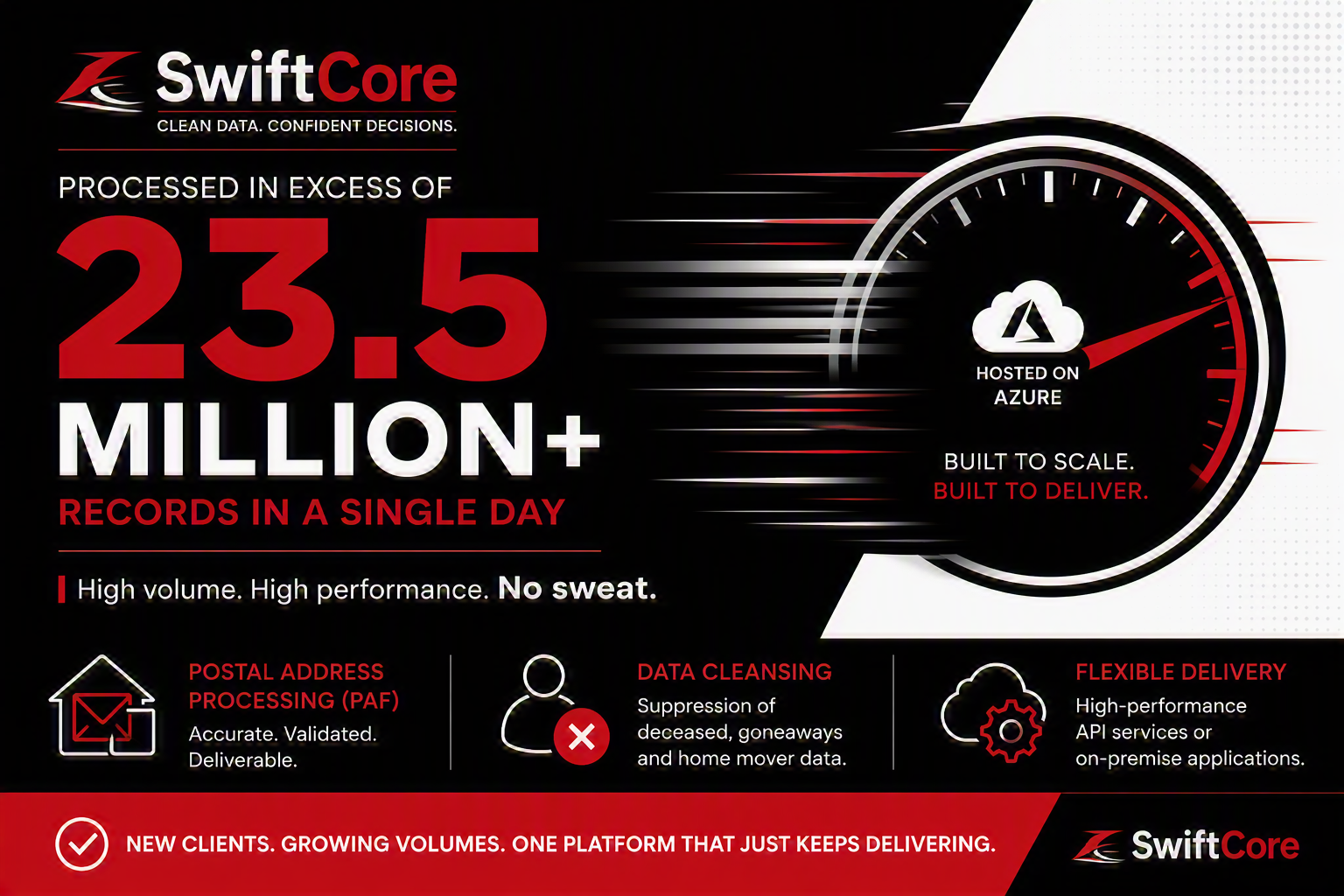
SwiftCore Powers Past 23.5 Million Records in a Single Day

By |2026-07-23T05:54:38+00:00July 23rd, 2026|

Last week marked another major milestone for the SwiftCore platform as it processed more than 23.5 million records in a single day. For most platforms, that kind of volume would be a serious test. For SwiftCore, it was simply business as usual. Built on Microsoft Azure, SwiftCore continues to deliver the performance, resilience and scalability our clients rely on every day. Whether processing Postal Address data through PAF services or running critical Data Cleansing activities, including suppression of deceased records, goneaways and home mover data, the platform continues to perform at scale. What makes this achievement even more impressive is that record volumes are growing as new organisations adopt SwiftCore's capabilities. Clients are choosing the platform through both high-performance API [...]

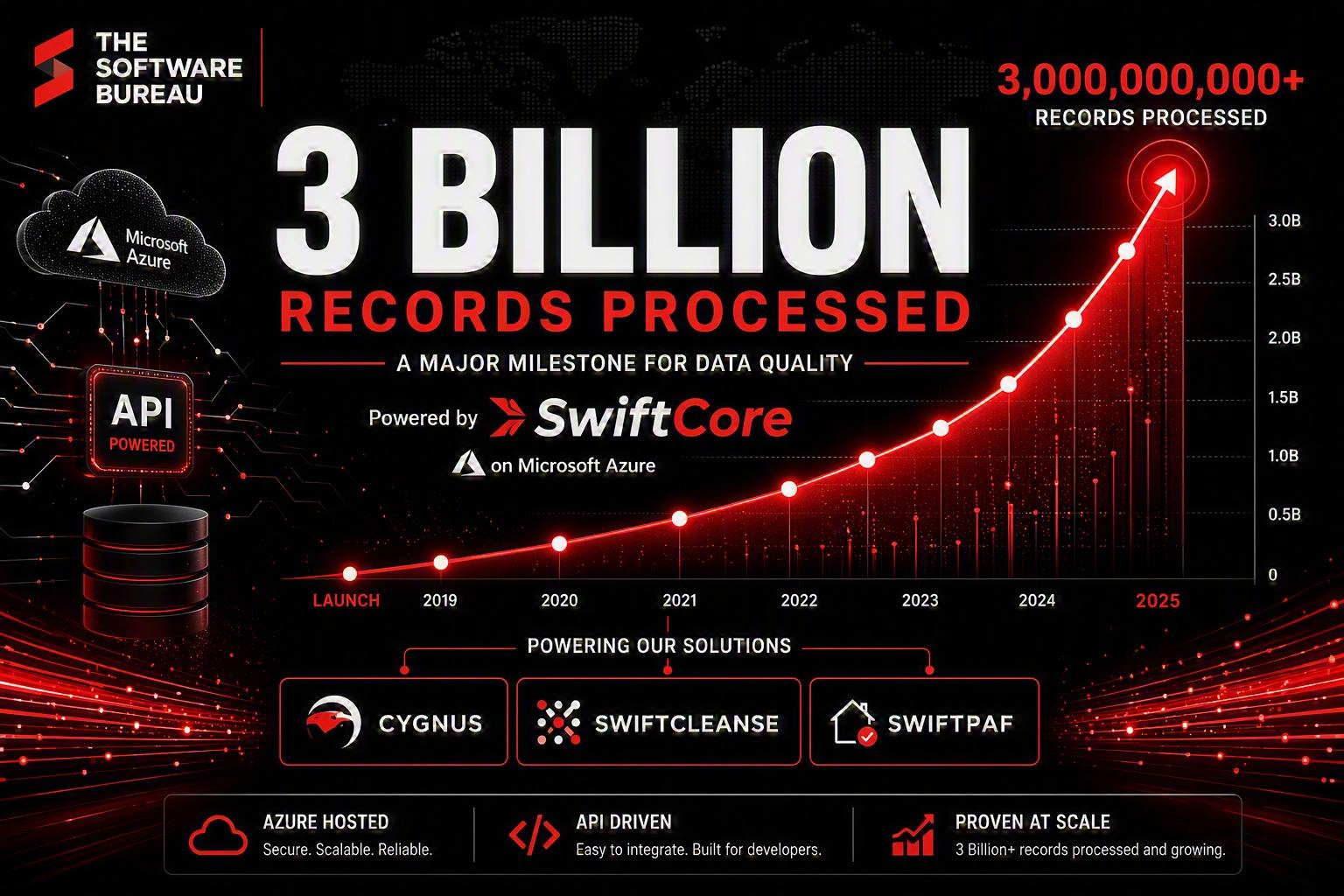
SwiftCore Surpasses 3 Billion Records Processed: A Landmark Achievement for Data Quality

By |2026-07-08T10:11:27+00:00July 8th, 2026|

We're proud to announce that the SwiftCore Platform has now processed more than 3 billion records since launch. This latest milestone represents far more than an impressive number. It reflects the growing demand for high-quality data, the confidence our customers place in our technology, and the proven scalability of a platform that powers some of The Software Bureau's most trusted solutions. As organisations continue to place increasing importance on data accuracy, compliance, customer insight, and operational efficiency, SwiftCore has established itself as the engine driving data quality innovation across our product portfolio and beyond. A Cloud-Native Data Quality Platform Built for Scale Hosted on the Microsoft Azure Cloud, SwiftCore delivers enterprise-grade data quality services through a powerful suite of APIs [...]

The History of Royal Mail’s Postcode Address File (PAF): A Timeline of Addressing Evolution

By |2026-06-10T09:27:23+00:00June 10th, 2026|

The Royal Mail’s Postcode Address File (PAF) is one of the most important yet often overlooked datasets in the UK. It underpins everything from mail delivery to e-commerce checkouts, credit checks, and emergency response systems. But PAF didn’t appear overnight. It evolved over decades alongside changes in addressing, technology, and society. This post explores the history and evolution of PAF, from the early days of postal districts to the digital infrastructure we rely on today. Before PAF: The Foundations of Modern Addressing (Pre-1970) 1850s–1910s: Postal districts and sorting efficiency Major cities such as London began using postal districts (e.g. “EC” or “SW”) in the mid-19th century. These were introduced to improve sorting efficiency as urban populations grew rapidly. However, outside [...]

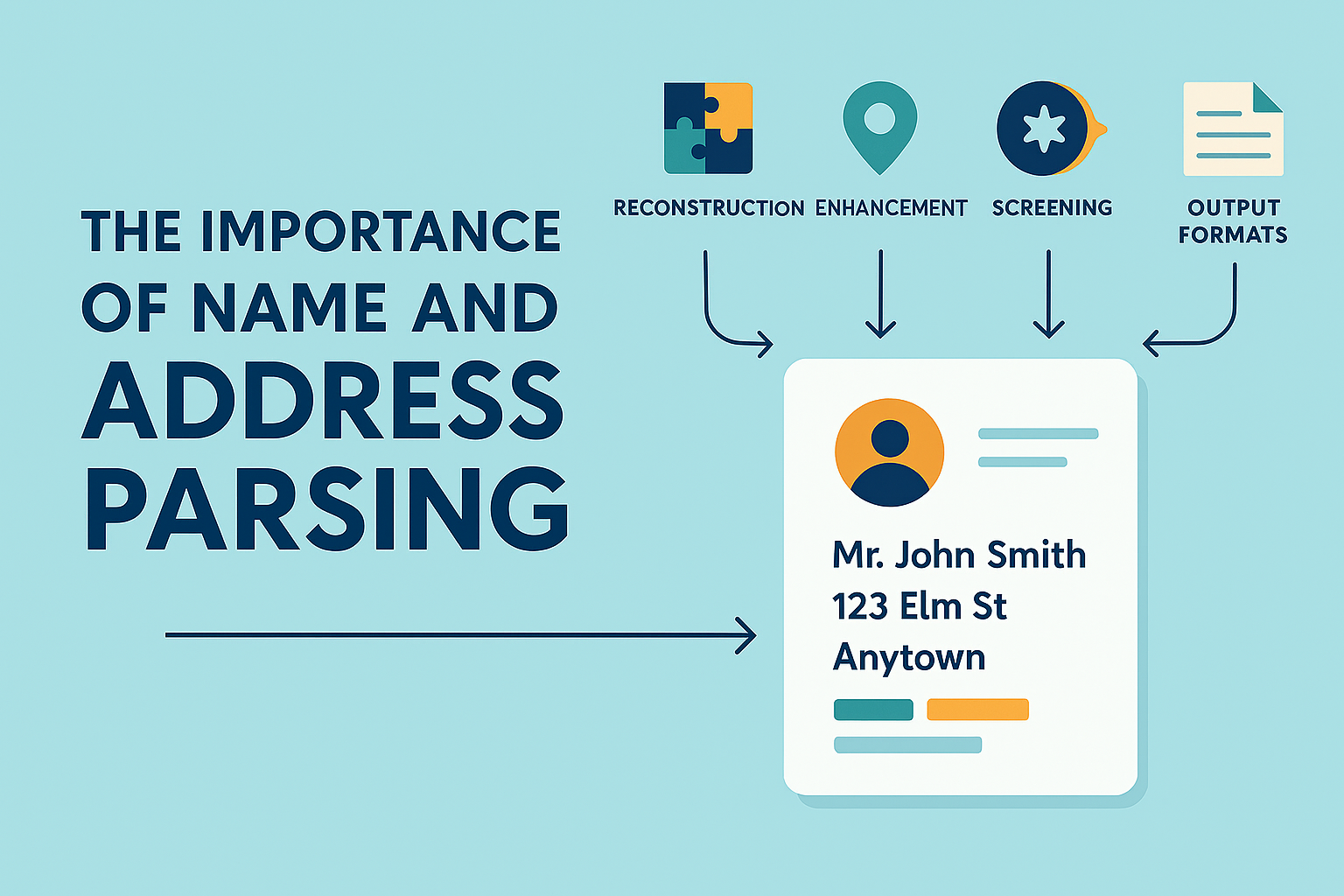
Why Name and Address Parsing Is the Foundation of Every Data Quality Success

By |2026-05-11T14:47:09+00:00May 11th, 2026|

What is the single most important capability behind every effective name and address solution? Accurate parsing. Before data can be enhanced, cleansed, screened, sorted or reformatted, it must first be understood. Name and address parsing is the process that makes that understanding possible, transforming raw text into structured, reliable components that software can act on with confidence. At The Software Bureau, parsing is not a feature. It is the foundation. Parsing: the invisible engine of data quality Every contact record starts life as unstructured data. Names arrive in countless formats. Addresses vary by country, convention, abbreviation and free‑form input. Titles, suffixes, building names, sub‑premises and delivery points are often mixed together in ways that defy simple rules. Without accurate parsing, [...]

Why Returned Mail Can No Longer Be Ignored: An Industry Wide Call to Action

By |2026-04-13T08:55:14+00:00April 13th, 2026|

Returned Mail has long been an inconvenient truth in the UK postal ecosystem. Despite its scale, cost and operational drag, it remains largely unmeasured and therefore unmanaged. My recent LinkedIn post highlighted a simple but troubling reality: Royal Mail continues to double handle significant volumes of Return to Sender mail without recording volume, root cause or resulting waste. This is not solely a Royal Mail issue. It represents a wider industry failure to create effective feedback loops that improve address quality, reduce waste and lower costs for everyone involved. It is time to move this conversation beyond anecdote and towards collective action. The Silent Cost of Returned Mail RTS mail remains one of the least transparent operational processes within Royal [...]

Celebrating a Major Milestone: 2 Billion Records Processed Through Our Cloud PAF Engine

By |2026-03-30T10:17:23+00:00March 30th, 2026|

We have reached an important moment in our journey. Our cloud PAF engine has now processed more than 2 billion records since launch. It is a milestone that speaks to the strength of our technology, the ambition behind our platform strategy, and the trust our clients place in us every day. This achievement is not just about volume. It is a demonstration of the speed, reliability and scalability that sit at the heart of our data processing architecture. SwiftPAF Joins the SwiftCore Ecosystem The phased roll out of our centralised PAF processing has taken another major step forward. Earlier this month, our SwiftPAF application was successfully connected to SwiftCore, marking a key moment in the evolution of our processing framework. [...]

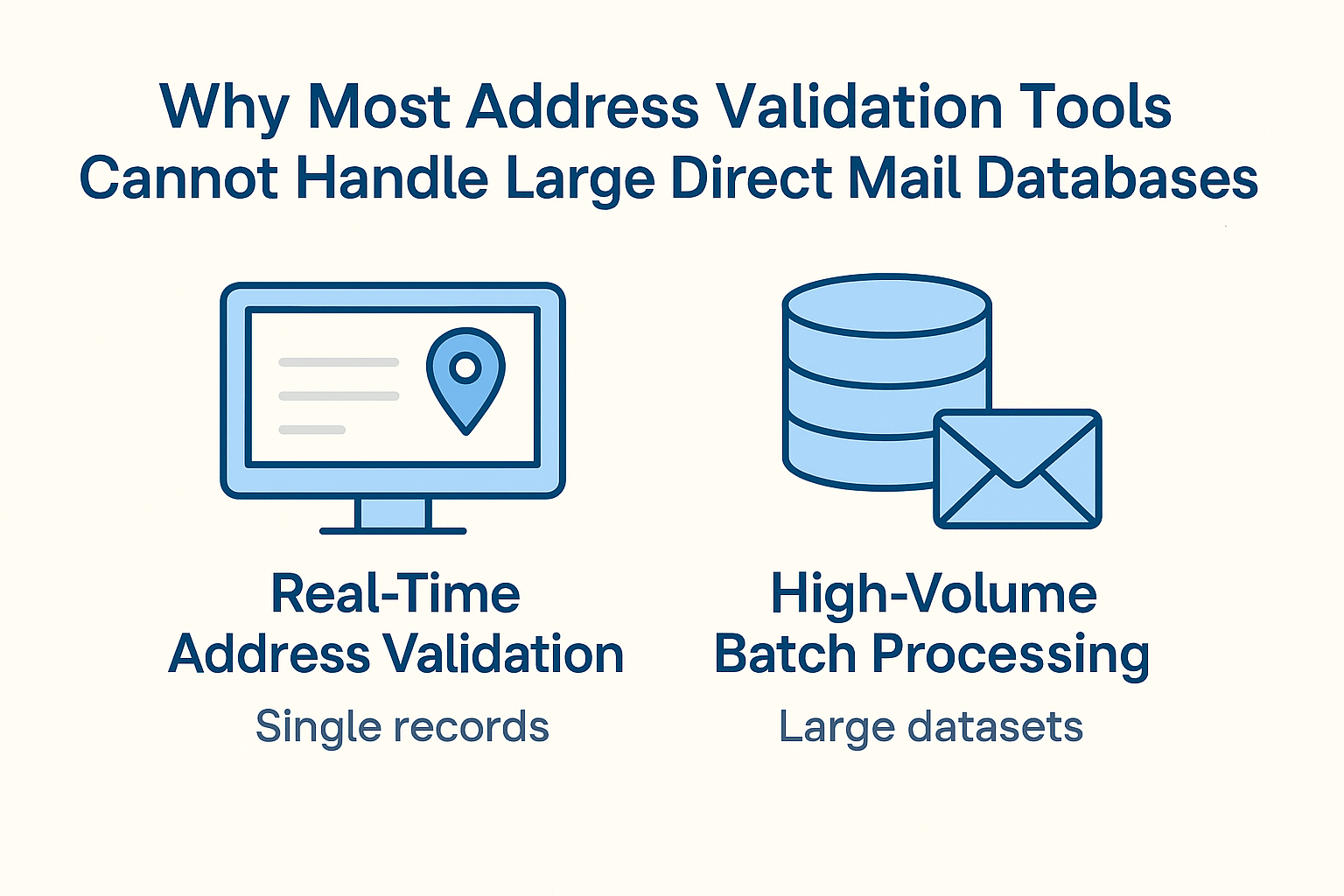
Why Most Address Validation Tools Cannot Handle Large Direct Mail Databases

By |2026-03-11T11:45:42+00:00March 11th, 2026|

In data marketing, scale determines everything. Validating a single address on a web form is fundamentally different from processing tens or hundreds of millions of customer records for a direct mail campaign. Many organisations assume that the same address validation tools can support both scenarios. They cannot. The gap between real-time address validation and industrial-scale batch processing is significant. Misunderstanding that difference often results in long processing times, inefficient workflows and delays in direct mail production. This article explains why large-scale data processing requires specialist software and how The Software Bureau supports these high-volume environments. Real-Time Address Validation vs High-Volume Batch Processing Most modern address validation services are designed for real-time usage. A typical example is a consumer entering an [...]

Driving Excellence: How Our Continuous Improvement Programme Transforms Address Verification

By |2025-12-17T12:17:43+00:00December 19th, 2025|

Introduction Accurate data is the foundation of effective communication. For organisations that rely on postal addresses, even small errors can lead to wasted mailings, lost customers, and unnecessary costs. At The Software Bureau, we take this challenge seriously. That’s why, 12 months ago, we introduced our Continuous Improvement Programme (CIP), a unique initiative designed to ensure our cloud-based Postal Address verification and enhancement engine is always learning and improving. What is CIP? CIP is not just a process, it’s a philosophy. It represents our commitment to delivering the most accurate and efficient address verification solutions on the market. Every time our system encounters a record flagged as poor quality, that record is anonymised and collated for review. This approach allows [...]

Building Smarter, Faster and More Scalable Data Apps with the SwiftCore API Suite

By |2025-10-27T10:14:12+00:00October 27th, 2025|

At The Software Bureau, we have always believed that technology should make life easier, not harder. That is exactly what our SwiftCore API suite delivers: a set of powerful, cloud-hosted APIs designed to help you create your own self-serve web applications for your clients with minimal fuss. Calling our web APIs is refreshingly simple. Any competent developer can get started quickly and integrating them into your own web platform is a lightweight task that does not require a full development team or a huge budget. The result? You can offer your customers secure, scalable, self-serve access to address data enhancement, suppression screening and more, all powered by our proven SwiftCore technology. Behind the scenes, our APIs are driven by Microsoft [...]

The Alpha-Numeric Backbone: A Data Manager’s Take on the UK Postcode History

By |2025-10-22T07:17:08+00:00October 22nd, 2025|

As a Data Manager, few things are as satisfying as a well-structured, consistent, and universally adopted dataset. In the UK, the postcode system is a prime example of this data harmony. It is more than just a sequence of letters and numbers; it is a critical piece of infrastructure, a tool for logistics, planning, and analysis. But how did this essential system evolve into the sophisticated data structure we use today? The Early Days: Before the Code Before the systematised codes, postal workers relied on geographical knowledge and local sorting districts. The first step toward standardisation came in the mid-19th century. 1857: London was divided into 10 postal districts (E.C., W.C., N., S.W., etc.), which were essentially the predecessors to [...]

Go to Top