The UK on-premise and cloud data quality alternative. A practical comparison for UK data teams reviewing alternatives as matchIT support winds down.
Quick summary
If you’re running matchIT today, whether that’s the desktop tool, the SQL Server integration or matchIT Web, and you’re weighing what comes next, this is a practical comparison of what a move to The Software Bureau looks like.
Dozens of organisations have made the switch from matchIT to The Software Bureau over the years, and with an increasing number of enquiries from matchIT customers we put together the following comprehensive guide to help explain the differences.
Short version: matchIT was built as a technical matching engine for UK data teams and became a fixture at mailing houses, charities, insurers and corporate data operations. With support and development winding down in the UK, teams face a choice between the enterprise successor product (higher-priced, consulting-led and cloud-centric) and a small number of alternatives.
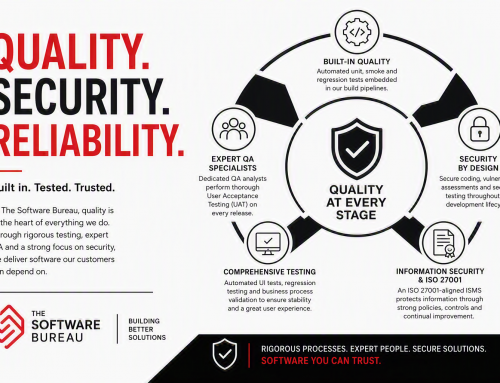
The Software Bureau is one of those alternatives and arguably the most UK-native. We were founded to solve exactly this problem: reliably parsing and matching UK contact data at scale. That work has been the heart of our business for nearly three decades. We hold current Royal Mail PAF accreditation, ISO 27001 certification and embedded licences for all of the UK’s major suppression data files. We process billions of records per year across all three deployment shapes matchIT users are used to: desktop, command-line and API.
If you want the detail, keep reading. If you’d rather just have a conversation, book a discovery chat with our technical team or start a free trial. You can also read more on our matchIT alternative page.
ON THIS PAGE
- Why UK matchIT users are reviewing their options
- What UK data teams actually need from a matching platform
- The Software Bureau, at a glance
- Feature-by-feature comparison
- On-premise, cloud, or both: choosing the right deployment
- The Console Parsing App: built for teams making this move
- UK-specific capability: PAF, Mailmark and suppression
- Support, pricing and vendor stability
- Making the switch: what a migration actually looks like
- Frequently asked questions
1. Why UK matchIT users are reviewing their options
matchIT, originally built by helpIT Systems in the UK, acquired by 360Science, then Syniti and then absorbed into Capgemini in late 2024, has served as a trusted matching engine for organisations that needed on-premise control and SQL-driven workflows. For over two decades it’s been one of the tools chosen by companies and charities running high-volume mailings, organisations of all kinds managing donor or customer deduplication, and enterprise data teams building single customer views.
That position is now changing. Support and development for the standalone matchIT products in the UK are winding down through 2026. The migration path being offered by the current owner is a significant departure from what many customers are used to, with consulting and significant licence costs.
For some organisations that path will fit. For many others, particularly UK-focused operations with defined data quality needs, mid-market budgets and on-premise requirements, it will not.
2. What UK data teams actually need from a matching platform
Before comparing products, it’s worth naming the requirements clearly. UK data teams running matching workflows need most or all of the following.
- Configurable matching logic. Rule-based fuzzy matching with phonetic keys, tuneable thresholds and multiple levels of grouping (individual, family and household).
- On-premise deployment. For charity, insurance, financial services and public sector data teams, on-premise processing is often a governance requirement.
- Deployment flexibility. Some workflows run in a desktop UI. Some run overnight from the command line. Some are called in real time from application code. A serious matching platform supports all three.
- UK address verification and standardisation. Royal Mail PAF accreditation. If mail is involved then Mailmark and NCOA support are increasingly essential.
- Embedded UK suppression data. Access to goneaway, deceased and home mover suppression files without having to negotiate separate licences with each data owner.
- UK-based support. When something breaks at 3pm on a deadline you need to be able to speak to a real person with experience of data processing, granular matching, PAF and all of the common challenges of harmonising disparate data sets at scale.
- Predictable, transparent pricing. Not an enterprise contract negotiation with a mandatory services package attached.
- A vendor that isn’t disappearing. After the last few years of consolidation in this market, buying from a stable, focused UK vendor is a rational commercial choice.
Most matchIT users we have spoken to have ticked every one of these boxes when describing what they need. What follows is how The Software Bureau maps against each.
3. The Software Bureau, at a glance
How the business started
The Software Bureau was founded in 1998 to solve a specific technical problem: how to reliably parse and match UK contact data at scale. Names spelled six different ways. Addresses missing lines, formatted inconsistently or entered in the wrong fields. Records that referred to the same person but no existing systems could work out that they did.
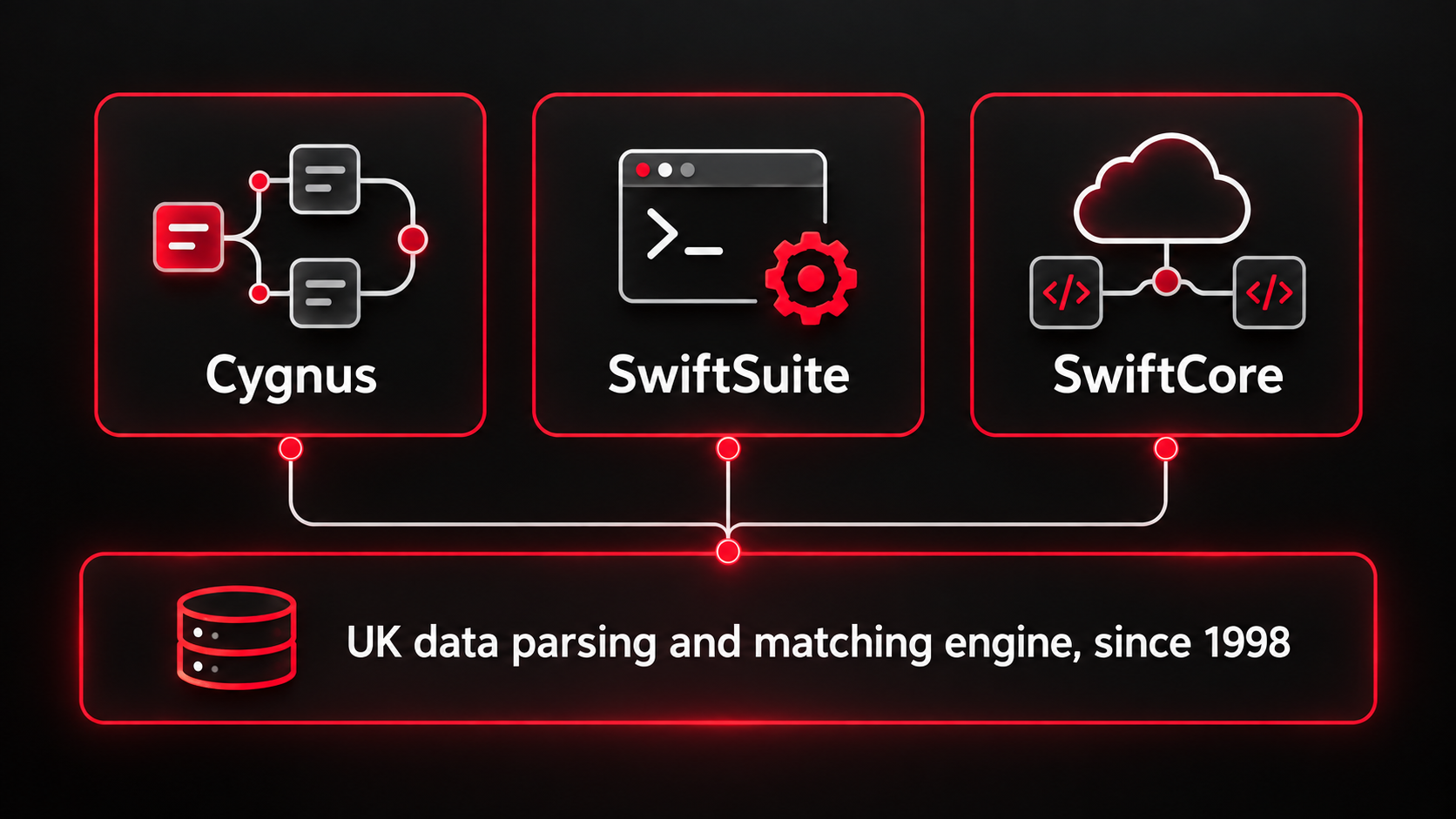
Solving that problem became the foundation of everything we’ve built since. Every product in our current family, from Cygnus and SwiftSuite to the SwiftCore API, rests on a matching and parsing engine we’ve been refining for close to thirty years. Data hygiene, deduplication, single customer view, address verification, suppression: it all sits on top of the same core capability.
Nearly three decades on, the market we serve is broader and the use cases more varied, but the underlying problem hasn’t changed. UK data is still messy. Charities, mailing houses, insurers and data teams still need to know who is who. And the people who build and support the tools that solve that problem still matter.
Who we are today
We build and support UK data quality and processing software directly from here in the UK. We serve over 100 clients including top charities, insurance companies, mailing houses and data bureaux.
Our product family covers the full data matching, hygiene and mail preparation workflow:
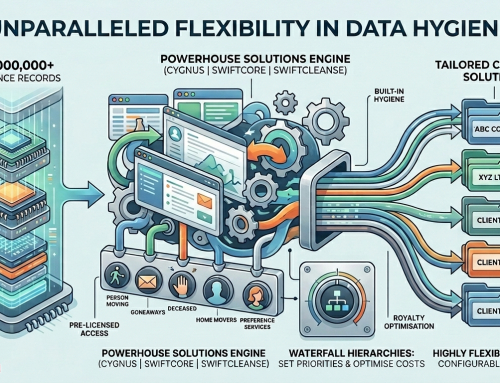
- Cygnus is a desktop processing suite with a canvas-style interface and fifteen modules enabling diverse parsing, matching, merging, deduplication, PAF, suppression, sortation and more. Perfect for complicated and diverse single customer view work.
- SwiftSuite is a set of desktop-based tools for matching, deduplication, cleansing, PAF validation, sortation and more. Best for high volume, automated workflows.
- SwiftCore is a REST API in the cloud for real-time hygiene, matching and address validation, with no infrastructure to manage. Used for API-driven hygiene and PAF validation and enhancement at high volume.
We have our own Royal Mail PAF solution, ISO 27001 information security certification, undertake regular external penetration testing and have negotiated embedded licences for all of the major suppression and hygiene providers from Royal Mail, Experian, Sagacity, DBS Data, MiExact and Shine CK, totalling over 450 million records.
The Software Bureau is an employee-owned UK business under an Employee Ownership Trust structure, which means we have no exit timer, no parent company restructuring and no plans to move support overseas.
4. Feature-by-feature comparison
The table below compares matchIT (across its historical product family: matchIT Desktop, matchIT SQL and matchIT Web) against The Software Bureau’s product family, on the criteria that matter most to UK data teams.
| Capability | matchIT | The Software Bureau |
|---|---|---|
| Fuzzy matching with phonetic keys | Proprietary algorithms | Double Metaphone phonetic keys, tuneable thresholds |
| Multi-level matching | Individual, household and business | Individual, family and household in a single pass |
| Golden record / survivorship | Rule-based | Matching outputs support user-defined survivorship rules |
| Hazard / offensive content detection | Not standard | Built-in, flags problematic content before it reaches your database |
| UK PAF accreditation | Historically yes | Current PAF accredited, 2 billion+ records processed |
| Embedded UK suppression data | Not embedded, licensed separately | Embedded licences for Royal Mail, Experian, Sagacity, DBS Data, MiExact and Shine CK |
| Mailmark and NCOA support | Partial, via configuration | Native, built-in |
| On-premise deployment | Yes | Yes (Cygnus and SwiftSuite) |
| Cloud API deployment | Available via Syniti Knowledge Platform | Yes (SwiftCore, no infrastructure to manage) |
| Command-line automation | Available | Yes (SwiftSuite) |
| UK-based support | Reduced UK presence post-acquisition | UK-based team with direct access to technical experts |
| Support model | Increasingly consulting-led | Included with licence, no services attach required |
| Ownership | Capgemini (public multinational) | Employee-owned UK Trust |
| Pricing model | Enterprise contract, often bundled with services | Mid-market pricing, licence-based |
| ISO 27001 certification | Available at Syniti platform level | Current, independently audited |
About this comparison. The matchIT capabilities described here reflect our understanding of the product family (matchIT Desktop, matchIT SQL and matchIT Web) based on publicly available documentation, product reviews and industry knowledge. matchIT and its capabilities may have been updated by Syniti or Capgemini since this piece was published. If you notice anything that should be corrected, please get in touch and we’ll update the comparison.
5. On-premise, cloud, or both: choosing the right deployment
Historically, matchIT SQL and matchIT Desktop were on-premise products, running against a customer’s own SQL Server infrastructure or on their own workstations. That deployment model suited regulated industries, sensitive customer data and any organisation with a governance requirement to keep data in-country.
The Syniti Knowledge Platform is a cloud-first product. That’s an appropriate direction for enterprise SAP transformation programmes but it introduces genuine friction for teams whose operational model is built around on-premise processing.
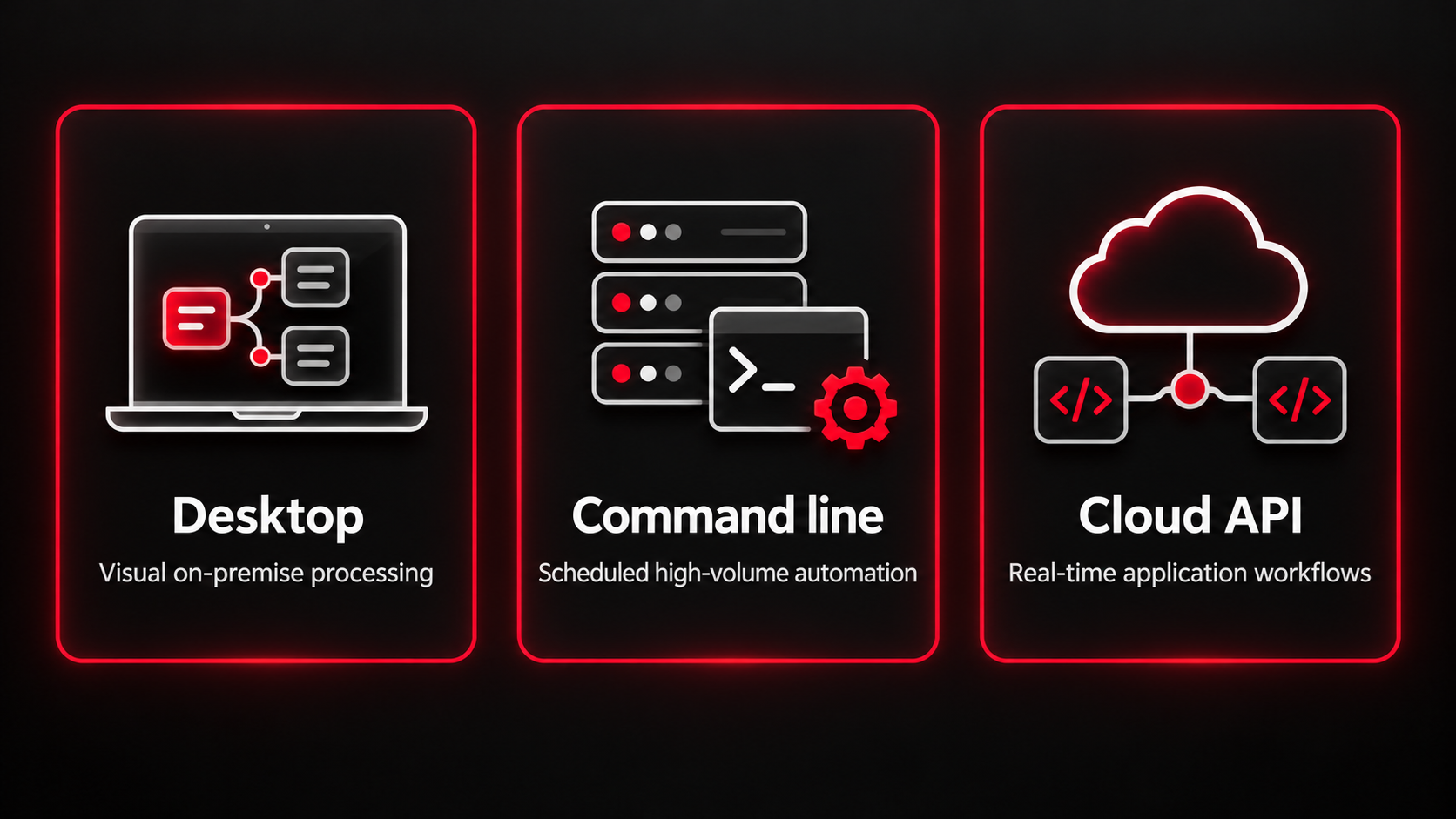
The Software Bureau supports all three deployment shapes with the same underlying matching and hygiene logic:
- Cygnus runs entirely on-premise, on the customer’s own hardware.
- SwiftSuite runs from the command line, either on-premise or in a customer-controlled environment.
- SwiftCore provides a cloud REST API either for single record or batch workflows that benefit from real-time processing.
If your requirements change over time, whether that’s a new client, a new procurement requirement or a new integration, you can move between these products without starting from scratch.
6. The Console Parsing App: built for teams making this move
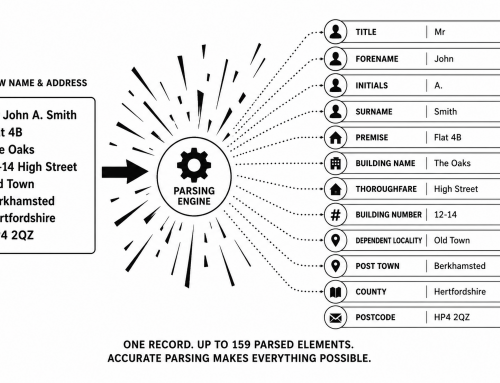
Alongside the existing product family, The Software Bureau is developing the Console Parsing App: a focused, on-premise tool designed specifically for UK name and address parsing and match key generation.
The Console Parsing App is being developed alongside a UK data bureau who were looking for a matchIT alternative. It concentrates our parsing heritage into a lightweight, focused tool for the specific job of turning messy UK contact data into structured, keyed records ready for matching workflows.
Key features
- Full UK name and address parsing including title, forename, surname, gender identification, marital status and territory
- Multi-level address parsing covering organisation, department, job title, house, building, flat, floor, room, block, thoroughfare, locality, town, county and postcode
- Match key generation using the Double Metaphone phonetic algorithm
- Individual, family and household-level match keys produced automatically
- Hazard detection flagging offensive or problematic content in names and addresses before it reaches your database
- On-premise deployment with no reliance on external APIs for parsing and key generation
- Structured outputs ready for matching workflows and SQL-based environments
The Console Parsing App is deployed on-premise, giving organisations full control over sensitive customer data. It’s positioned to complement match key workflows that teams already know and rely on, without requiring them to redesign those workflows from scratch.
The Console Parsing App is available for early proof-of-concept engagements. Talk to us about your matching setup to arrange one.
7. UK-specific capability: PAF, Mailmark and suppression
This is where UK data teams find the biggest structural gap between international alternatives and a UK-focused vendor like The Software Bureau.
Royal Mail PAF accreditation. We’re a PAF-accredited software supplier, meaning our address validation is licensed, up-to-date and has processed over 2 billion records. For any UK data workflow this is not optional, but it’s often overlooked by US-headquartered alternatives.
450 million embedded UK suppression records. We hold licences for the UK’s major suppression and hygiene files: Royal Mail’s own goneaway data, Experian’s home mover file, Sagacity’s deceased suppression, DBS Data, MiExact and Shine CK. Combined, that’s over 450 million records of UK suppression data available for you to use in any sequence you like. Most matchIT users currently manage separate contracts and integrations with each of these data owners, each with minimum spend commitments and reporting requirements. Moving to us reduces overall cost, simplifies the process and improves accuracy.
Mailmark support. We’ve supported Mailmark from launch, which matters for mailing houses who need to ensure they’re benefitting from the most cost-effective rates.
NCOA support. Royal Mail’s Change of Address service is integrated into our workflow, with support for both current and historical NCOA files.
All of this is native to The Software Bureau’s product family.
8. Support, pricing and vendor stability
Three practical questions come up on almost every matchIT migration conversation.
How do we compare what you provide to what we already have?
Most projects begin with some kind of proof of concept on your own data, or a migration review. From there we can help identify the right products for your requirements and you can be confident you’ll achieve the same or improved results.
How do you provide support?
The Software Bureau’s support team is UK-based. When you call, you speak to someone who understands the specific matching challenges of UK contact data. No time zones, no offshore escalation queues and no ticket routing across continents.
What does it cost?
Our licensing is mid-market by design. We work with in-house data teams, charities, mailing houses and data bureaux, and our pricing reflects that. The base software is licensed on a transparent and predictable basis, not bundled with an enterprise consulting engagement.
Are you still going to be here in three years?
The Software Bureau is an employee-owned UK business under an Employee Ownership Trust structure established in August 2025. That structure means there’s no external investor exit timer, no parent company reshuffle and no strategic decision on the horizon that would move our operations, our data or our support overseas. We’re a small, focused UK business with no plans to change.
9. Making the switch: what a migration actually looks like
Migration from matchIT to The Software Bureau typically follows the following path:
- Discovery. We’ll walk through your current matchIT setup, match rules, deployment shape and downstream systems to identify what’s needed.
- Mapping. Your existing match rules and configurations map onto The Software Bureau’s matching engine.
- Parallel run. You keep matchIT running while we run the same workflow through TSB. Results are compared. Any discrepancies get investigated and, where necessary, rules tuned.
- Switchover. Once you’re comfortable, you switch over. matchIT is retired at your pace.
- Ongoing. Support continues from our UK team. You have direct access to the people who understand your setup.
For teams with more complex requirements, whether that’s multiple matching pipelines, embedded integrations or custom rules developed over years, the timeline extends but the shape is the same. We’ve done this a fair number of times so we understand you need to be confident of continuity before making the switch.
10. Frequently asked questions
Is The Software Bureau a direct replacement for matchIT?
We’re an independent UK alternative, not a successor product. Our software handles the same core jobs (matching, deduplication, single customer view, golden record creation, address verification and suppression) for UK data teams who want a supported, mid-market option. We’re not affiliated with helpIT, Syniti or Capgemini.
Will my existing match rules work in your software?
The matching logic familiar to matchIT users (multiple definitions with OR logic, criteria with AND logic, multi-level grouping and phonetic keys) maps onto our matching engine with configuration work rather than a rebuild.
What if we use matchIT through SQL Server or as a web service?
We support a range of deployment shapes: desktop processing (Cygnus), command-line and scheduled automation (SwiftSuite) and REST API for real-time PAF and hygiene (SwiftCore). Whichever way your team works today, there’s a corresponding workflow in our platform.
How much does it cost?
Mid-market pricing based on the workflow, deployment shape and licence terms. Predictable and transparent. We’ll give you a full quote after a discovery conversation.
Have other teams already moved from matchIT to The Software Bureau?
Yes, dozens over the years and several are actively migrating to us right now.
How long does a migration typically take?
Four to eight weeks from first conversation to running in parallel for most teams, plus a stabilisation period.
Talk to us
If you’re reviewing matchIT alternatives or just planning ahead for a renewal decision that’s coming, we’d welcome the conversation. No procurement engagement required — a 30-minute discovery chat is where most conversations start.
matchIT, helpIT and Syniti are trade marks of their respective owners. The Software Bureau is an independent UK software vendor and is not affiliated with, endorsed by or connected to those brands.