15 Years of Direct Mail Innovation: Our Journey at The Software Bureau

By |2025-12-03T08:45:41+00:00December 3rd, 2025|

Direct mail has proven to be one of marketing’s great survivors. As highlighted in Decision Marketing’s recent retrospective, the past 15 years have been a period of constant evolution for the UK direct mail industry. Rising costs, changing consumer expectations and the digital revolution have all played their part in reshaping the landscape. Through it all, The Software Bureau has been proud to stand at the forefront of innovation. Demystifying Complexity When we started, one of the biggest challenges for mailers was navigating the complex world of data sortation for postage discounts. Our mission was simple: make this process accessible and efficient. By developing intuitive software solutions, we helped businesses unlock savings without the headaches. Championing Data Quality As the [...]

Understanding the Mailing Preference Service: What It Is (and When You Need It)

By |2025-11-12T13:47:06+00:00November 12th, 2025|

The Mailing Preference Service (MPS) is one of the most important suppression files in UK direct mail. Managed by the Data & Marketing Association (DMA), MPS allows consumers to opt out of receiving unsolicited mail, that is, marketing they did not ask for and from companies they have no existing relationship with. In short, if you are sending cold mailings, the MPS is your best friend. It protects consumers’ preferences and keeps you compliant with best practice and data protection principles. When You Need to Use MPS Any business using third-party or prospect data for direct mail campaigns must screen against the MPS before mailing. This ensures that anyone who has opted out of receiving unsolicited marketing is removed from [...]

Building Smarter, Faster and More Scalable Data Apps with the SwiftCore API Suite

By |2025-10-27T10:14:12+00:00October 27th, 2025|

At The Software Bureau, we have always believed that technology should make life easier, not harder. That is exactly what our SwiftCore API suite delivers: a set of powerful, cloud-hosted APIs designed to help you create your own self-serve web applications for your clients with minimal fuss. Calling our web APIs is refreshingly simple. Any competent developer can get started quickly and integrating them into your own web platform is a lightweight task that does not require a full development team or a huge budget. The result? You can offer your customers secure, scalable, self-serve access to address data enhancement, suppression screening and more, all powered by our proven SwiftCore technology. Behind the scenes, our APIs are driven by Microsoft [...]

Handling Half a Billion Records: The Power Behind Our Data Cleansing Engine

By |2025-08-04T11:44:09+00:00August 4th, 2025|

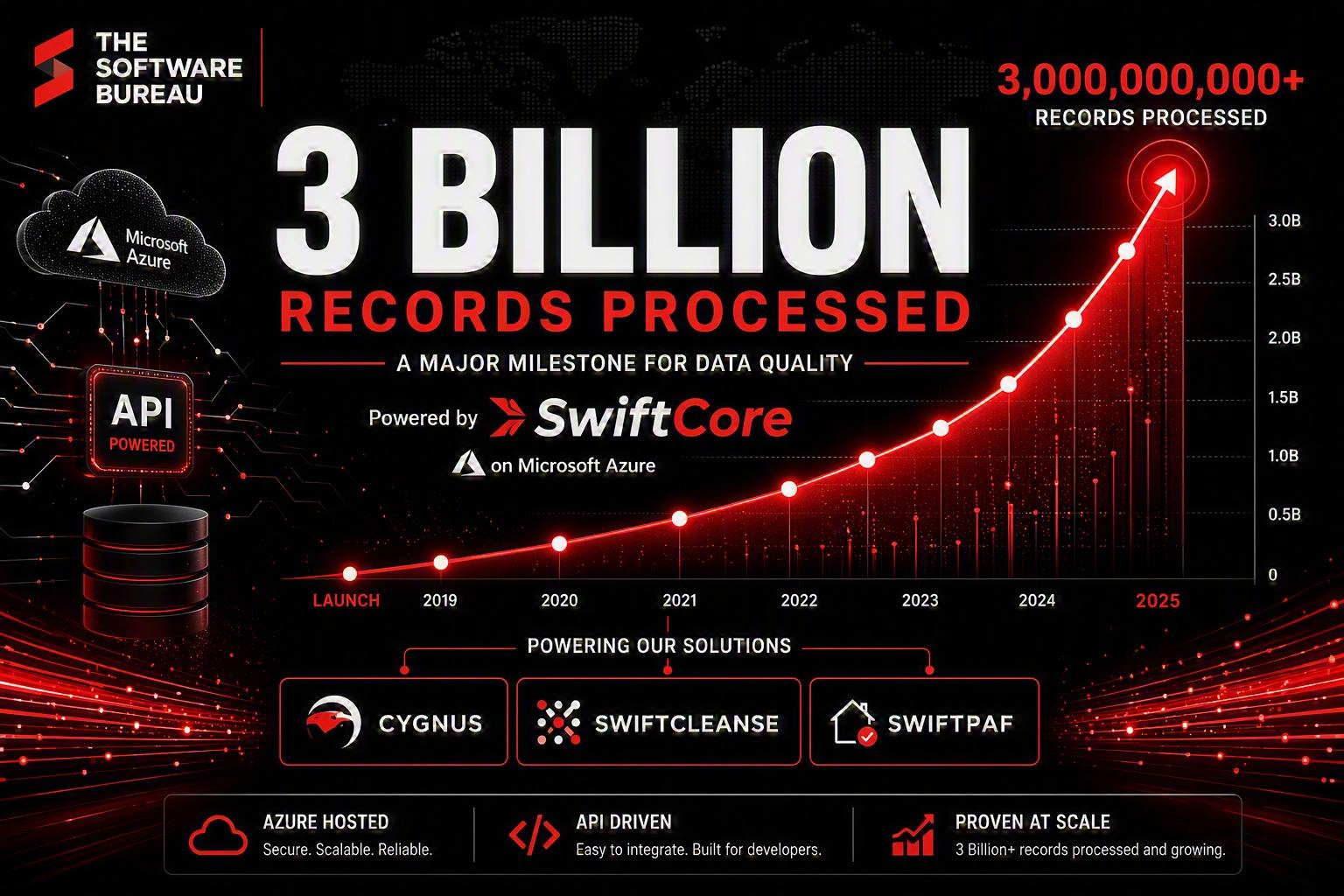
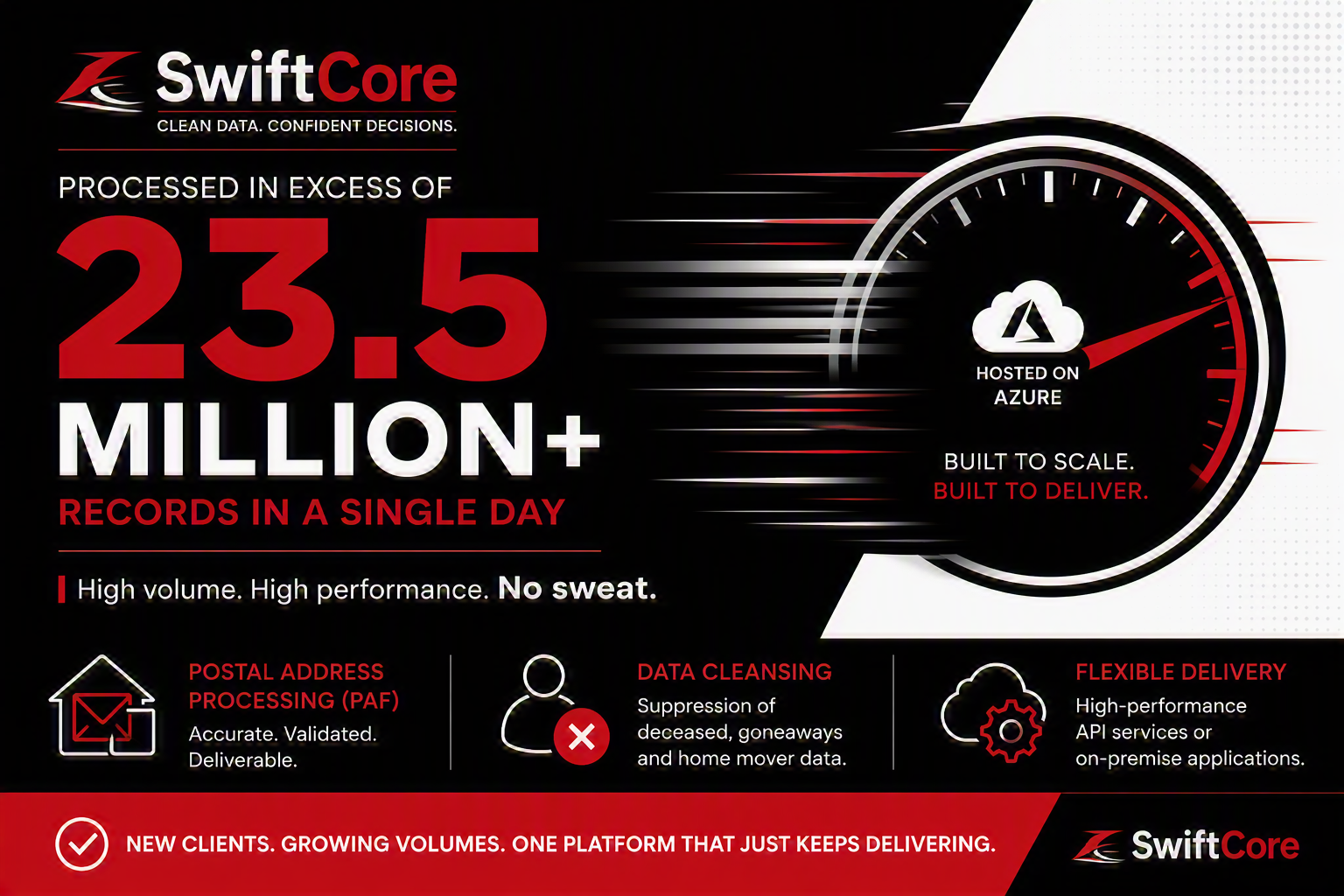
When it comes to data cleansing, volume matters. But so does variety, speed, security, and, above all, accuracy. At The Software Bureau, we manage a portfolio of suppression and home mover data so vast that it clocks in at around 500 million records—and growing. Every single one of these records comes from a trusted, vetted source, gets cleaned and enhanced, and is then deployed to our clients through our on-premise and cloud applications—quickly, securely, and without fuss. The Data Powerhouse Our centralised database is fed by some of the most respected and widely used data providers in the UK, including: Experian – Mortality, Absolute Contacts, Movers Sagacity – TBR, GAS, GASReactive MiExact – Mortascreen, NDR, Fression Royal Mail – BCF, [...]

The Data Breach Epidemic: A Wake-Up Call for Data Hygiene 

By |2025-06-02T14:59:09+00:00June 2nd, 2025|

Earlier this month, cybersecurity researcher Jeremiah Fowler uncovered an unsecured database containing over 184 million login credentials. This trove included usernames and passwords for major platforms such as Google, Apple, Microsoft, Facebook, Instagram, and Snapchat, as well as sensitive data from bank accounts, health services, and government portals. Alarmingly, the database was unencrypted and publicly accessible, making it a "cybercriminal's dream".  Closer to home, you can’t fail to have missed M&S’ significant cyberattack, leading to the theft of customer data, including contact details and order histories. The breach disrupted online operations and is projected to cost the company approximately £300 million in lost operating profit. The attack was reportedly executed by the cybercriminal group Scattered Spider, exploiting vulnerabilities in third-party [...]

What’s Going on with the Data (Use and Access) Bill?

By |2025-05-14T11:02:06+00:00May 14th, 2025|

On 14th May 2025, the UK’s Data (Use and Access) Bill reached a critical stage in Parliament, following heated debate over its implications for AI, copyright, and how data is shared. While the headlines have focused on creative rights and artificial intelligence, there’s a bigger picture emerging — one that matters to anyone involved in managing, using, or maintaining quality data. Originally introduced in late 2024, the bill aims to improve how data is accessed and used across the public and private sectors. It supports initiatives like digital ID systems and encourages wider data sharing to unlock innovation. But as it moves between the House of Commons and the Lords, disagreement over specific provisions — particularly a new transparency requirement [...]

Why the Campaign for Better Data Matters — and Why Data Hygiene is the Foundation

By |2025-05-07T09:21:22+00:00May 7th, 2025|

At The Software Bureau, we welcome the Market Research Society’s Campaign for Better Data. While it may sit adjacent to our core area of data processing, we believe the campaign’s central theme — building trust and credibility in data — is critical across every part of the marketing and insight ecosystem. With the UK Government positioning the nation as a leader in AI, the spotlight is rightly falling on the quality of the data feeding these tools. As recent studies have shown, there’s a growing gulf between organisations’ AI ambitions and the reality of their data capabilities. Misinformation, survey fraud, and outdated practices threaten to undermine not only AI, but also the credibility of every campaign or insight generated from [...]

Why Homemover Trends Mean Marketers Must Get Smart With Address Data

By |2025-04-17T09:21:06+00:00April 17th, 2025|

The Shift from Moving to Improving New research reveals that the traditional pattern of moving up – or down – the property ladder is being replaced by a trend for staying put and adapting the current home to suit evolving needs. According to The Way We Live Now 2025 report from B&Q, flexible working and multigenerational living are driving a major rise in DIY. Nearly two-thirds of families have remodelled their homes to accommodate changing needs, and many now see their current property as their ‘forever home’. A significant number have carried out or are planning major transformations, such as extensions or reconfigurations, while others are staying put due to financial pressures like mortgage affordability or lack of deposit. Meanwhile, [...]

23andMe Collapse Sparks Urgent Questions About Data Responsibility

By |2025-03-26T11:15:47+00:00March 26th, 2025|

Once a Silicon Valley darling, DNA testing company 23andMe has now gone into administration—leaving behind not just a troubled balance sheet, but a trove of highly sensitive personal data. Millions of customers entrusted the firm with their genetic information, family histories, and health predispositions. Now, the burning question: what happens to that data? The debate has ignited fears over data ownership, consent, and corporate accountability. In the UK, administrators are bound by GDPR, but the worry remains that valuable genetic data could be sold to settle debts, repurposed without consent, or exposed through weak security controls. This situation highlights a deeper issue: data stewardship isn’t just a technical obligation—it’s a moral one. Companies handling sensitive personal data, especially of the [...]

Why accurate data matters for outdated demographics

By |2025-03-19T12:34:15+00:00March 19th, 2025|

According to a study by Adlook marketers and agencies are wasting budgets and raising privacy concerns by relying on outdated demographic targeting. The research reveals major flaws in traditional segmentation methods based on age, gender, income, and lifestyle, highlighting the need for more accurate, privacy-conscious solutions. The Flaws in Demographic Targeting Adlook surveyed 1,325 online consumers to determine if they identified with the socio-demographic segments assigned to them through third-party cookie data. Results showed a significant disconnect between targeting assumptions and actual audience composition. For example, only 18% of those targeted as “Women 18-24” fit that profile, while 43% were men and 35% were over 55. Similarly, 52% of the “Mums” segment were men, and 62% had no children. Even [...]

Go to Top