In March 2025, Denmark made headlines by announcing the end of its national letter delivery service from the end of 2025. For many in the postal and communications industry, it felt like a glimpse into the future. Letter volumes in Denmark had collapsed by more than 90% since the turn of the century as consumers and businesses embraced digital communications.
Looking at the UK market today, it is difficult not to notice some uncomfortable similarities.
Letter volumes continue to decline, Royal Mail is implementing major Universal Service Obligation (USO) reforms that reduce delivery frequency, and significant price increases are being introduced for bulk mail users from October 2026. Against that backdrop, an obvious question emerges:
Will the UK letters market still exist in 10 years’ time?
A Long-Term Decline That Shows No Sign of Stopping
The decline in UK letter volumes is far from a recent phenomenon. Data from Ofcom and Royal Mail has shown a sustained reduction in mail volumes for over two decades, driven largely by the digitisation of communication.
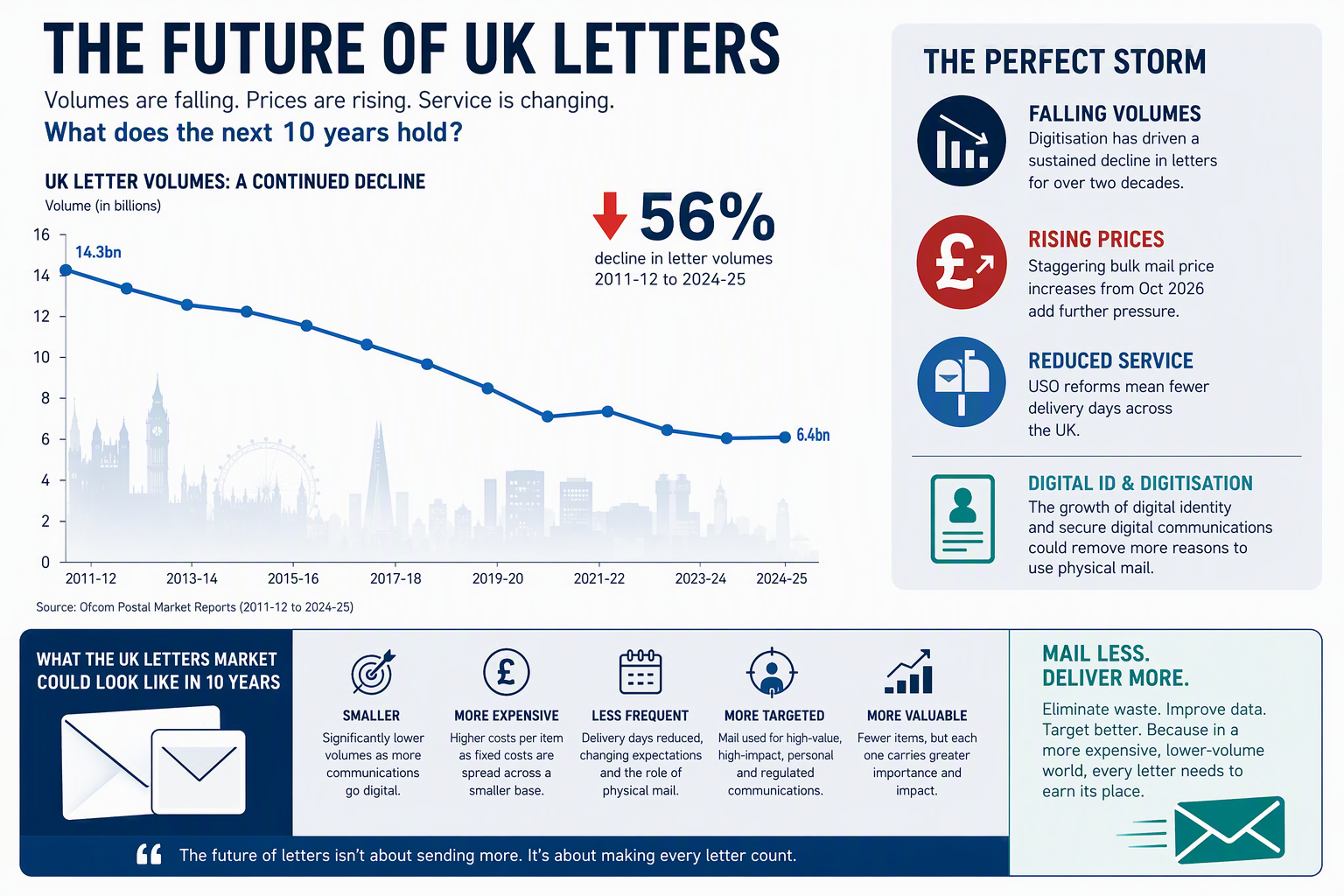
The data tells a stark story. UK addressed letter volumes fell from approximately 14.3 billion items in 2011-12 to 6.4 billion items in 2024-25, representing a decline of around 56% in just 13 years. – https://www.ofcom.org.uk/post/market-performance/monitoring_reports
The trend becomes even more striking when viewed alongside Denmark’s experience. While the UK has not yet seen the dramatic collapse witnessed in the Danish market, the direction of travel is undeniably similar.
Consumers who once received bank statements, utility bills, insurance renewals and government correspondence through the post now receive them digitally. Businesses that relied on direct mail increasingly allocate budget towards email, online advertising, apps and customer portals.
Every year, another category of communication disappears from the letterbox.
The Perfect Storm Facing UK Mail
Today’s letters market is experiencing pressure from multiple directions simultaneously.
- Falling Volumes
As volumes decline, the economics of letter delivery become increasingly challenging. The UK’s postal infrastructure was designed for a much higher volume environment. Fewer letters moving through the network means the fixed costs of processing and delivery must be spread across a shrinking number of items.
This creates a vicious circle:
- Volumes fall.
- Delivery costs per item increase.
- Prices rise.
- More customers seek digital alternatives.
- Volumes fall further.
- Rising Prices
Royal Mail’s latest bulk mail price increases are among the most significant the industry has experienced in recent years. For organisations sending millions of pieces of mail annually, the additional cost burden is substantial.
Many large mailers, particularly those sending transactional communications, may use these increases as an opportunity to accelerate digital migration programmes that were already under consideration.
The challenge for the industry is that every volume reduction makes the next price increase more likely.
- Reduced Service Levels
The introduction of USO reforms reflects a reality that would have been almost unthinkable a generation ago: daily letter deliveries are becoming harder to justify economically.
While the reforms may help Royal Mail create a more sustainable operating model, reduced delivery frequency changes customer perceptions of the service. If mail becomes less immediate, organisations may question whether it remains the right channel for time-sensitive communications.
Will Digital Identity Accelerate the Decline?
One of the biggest questions for the next decade is the impact of digital identity.
For years, physical mail has played a crucial role in verifying identity, delivering official communications and supporting regulatory compliance. However, as government-backed digital identity frameworks mature, many of these traditional uses for mail could disappear.
Imagine a future where:
- Government correspondence is delivered securely through digital identity platforms.
- Financial institutions communicate entirely through authenticated digital channels.
- Healthcare notifications are accessed via secure patient portals.
- Legal and compliance documents are delivered electronically with full audit trails.
If that future becomes widespread, significant portions of today’s transactional mail volume could vanish.
It is not difficult to see how the UK could follow a similar path to Denmark over the next decade.
But Is the Letter Really Dead?
Not necessarily.
While volume is declining, the value of physical mail remains surprisingly resilient.
In an era of overflowing inboxes, physical mail enjoys something digital channels often struggle to achieve: ATTENTION.
A well-targeted letter is tangible, trusted and difficult to ignore. For many brands, direct mail continues to deliver strong response rates when integrated with digital channels.
The future may not be about mass mailings sent to millions of households.
Instead, it may be about:
- Highly targeted communications.
- Personalised direct mail.
- Trigger-based campaigns.
- Premium customer journeys.
- Multi-channel marketing strategies where physical mail acts as a high-impact touchpoint.
In that scenario, mail evolves from a mass communication channel into a specialist one.
The volume declines, but the importance of each item increases.
The Industry’s Opportunity: Mail Less, Deliver More
If there is one lesson the industry should take from current market conditions, it is this:
The future belongs to organisations that mail smarter, not simply mail more.
As postal costs rise, every item sent needs to justify its existence.
Removing waste from mailing campaigns has never been more important. Poor-quality data, duplicate records, outdated addresses and irrelevant communications all drive unnecessary cost while reducing campaign effectiveness.
The principle of “Mail Less” is not about abandoning mail. It is about ensuring every communication has a purpose.
By improving data quality and targeting:
- Fewer items are wasted.
- Customer experience improves.
- Postal spend reduces.
- Campaign effectiveness increases.
- Mail remains sustainable for both brands and the postal network.
The result is that the mail which does get produced is far more likely to be delivered, opened and acted upon.
What Does the UK Letters Market Look Like in 2036?
Predicting the complete disappearance of letters would be bold. The UK is not Denmark, and there will likely remain a need for physical communications in certain sectors and demographics.
However, it is equally difficult to imagine a thriving, high-volume letters market a decade from now.
A more likely scenario is a market that is significantly smaller, more expensive and more selective.
The UK’s letter network may evolve into something resembling today’s parcel market: delivering fewer items but extracting greater value from each one.
The question, therefore, is not whether letter volumes will continue to decline. The evidence suggests they will.
The real question is whether organisations adapt quickly enough to ensure that the letters they continue to send genuinely matter.
Because in a world where every mailing costs more than the last, the most successful brands will not be those that mail the most.
They will be the ones that make every letter count.