When the deadline is set in stone and the brief keeps growing, the right data processing software can be the difference between meeting the deadline and winning the next job, or missing it and losing the client.
I was catching up with John Knight, who runs a data bureau called DPS Direct, and has been using Cygnus for over 20 years. Anyone in this corner of the industry knows the feeling. Print has a date, the mailing has a date, the schedule gets squeezed at both ends, and the data is always the last piece to drop into place. When it slips, or the brief changes at the eleventh hour, it is the data team left to pull it out of the bag. The real enemy is rarely complexity. It is time. John mentioned a job from the week before that sums it up, so I asked him to write it up. Here it is, in his own words.
In John’s words
It was supposed to be a one-day job. I had priced it as such from the original spec. Then, thanks to delays on other work, I did not get to start it until the morning it was due to proof. No problem, I thought, it is only a day’s work. Then I actually opened the final briefing docs.
Some of the variable elements were not clear, so I queried them, and back came three more documents: a copy document calling for a wide range of variable paragraphs tied to donation ask amounts, another paragraph tied to the donor’s history, and two lookup tables to drive it all. In other words, the one-day job had quietly become a much bigger one, and I still had to deliver by the next day. Mail dates do not move. You are one link in a long chain, and at that moment everyone is waiting on you.
“The enemy is time. Cygnus let’s us move quickly while still seeing and checking every step is what lets you get it right first time, under pressure, without cutting corners.”
John Knight, DPS Direct
Getting the data structured and clean first
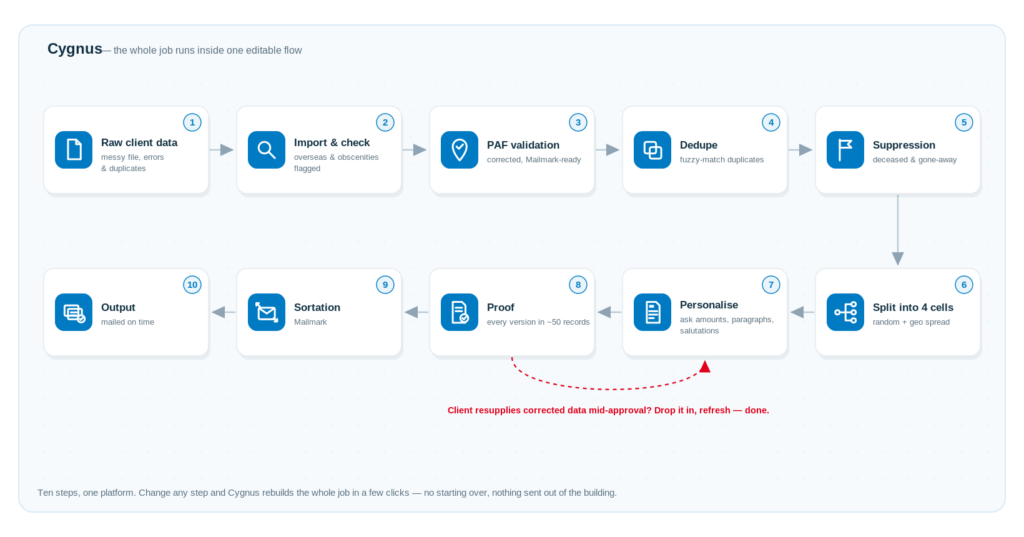
Every job starts the same way, by getting the data clean before you build anything on top of it. This one had a few overseas records that had been supplied with “United Kingdom” as the country, which would most likely have been rejected or lost in the post. They were flagged, I applied the correct country, and they could mail. Every record counts. Any one of them might be the client’s most valuable donor.
There were a couple of genuinely obscene records too, profanity sitting in a name or address field. Those came out. You can mail a hundred thousand perfect pieces, but it only takes one offensive letter landing on the wrong doormat to become a complaint, or worse, a story in the press. That is the client’s brand you are holding, and it is represented by the quality of the data you send out on their behalf. Then the health check: duplicates, people who have moved, and people who have died. I’m a strong believer that deceased screening in particular belongs on every campaign. A letter addressed to someone who has passed away causes real distress and does lasting damage to the relationship between a charity and a family. On this job that meant a handful of duplicates, around a hundred deceased and a couple of hundred gone-aways, all reported to the client to decide on before a penny was spent.
Where every job becomes its own puzzle
This is the point where a job stops being generic and becomes its own puzzle. The client wanted the data split into four cells: high value and standard value donors, each split again into two, and that second split had to be random but with a good geographical spread rather than simply cut down the middle. That is fiddly to do cleanly by hand. You end up counting, cutting and pasting thousands of records and still get lopsided selections. Instead I used a Cygnus function that deals the data out like cards into hands, evenly and randomly. Four clean cells, done.
Then the personalisation, which is where the real graft was. Three different ask amounts had to be appended to every record based on the donor’s giving history, driven by a lookup table with sixty variable paragraphs behind it. With Cygnus I quickly built a script which turned each giving value into a fixed-length code so anything from zero to £9.99 fell into one band, then matched each band to the right ask values and paragraphs. Some of those paragraphs were long. A lot of software falls over on fields beyond 255 characters. Thankfully Cygnus does not.
Little things matter here. Some of the ask values arrived without their pence properly formatted, so £5.50 was showing as £5.5. A short custom script padded everything to two decimal places and then stripped the .00 from round pounds, so £5.50 stayed £5.50 and £5.00 became £5. That is the sort of detail nobody thanks you for, but everybody notices when it is wrong.
“Dear Mr S”
Then the salutations. I ran a quick report and, as usual, it was a mess: an amalgamation of old data, new data and data gathered from who knows where. Some records had title and surname, some only a forename, some were blank, some were defaults like “Supporter” or “Friend”, and a couple of hundred were simply wrong. Nobody wants to open a letter that reads “Dear J” or “Dear Mr S”. I pulled out the bad ones, around two hundred, and rebuilt them from the title, forename and surname fields, with a sensible default for anything that could not be saved.
The dark art of proofing
People underestimate proofing. I have known it to take longer than the processing itself. The client needs to see every version of the mailing, every ask amount, every paragraph, every donor type, the longest and shortest names and addresses, examples of the default salutations, all of it, but they do not want a thousand proofs to wade through. On this job the full set of combinations ran into the thousands. The trick is to show all of it in as few records as possible. If you have fifty segments, twenty ask values and four Gift Aid versions, that is four thousand possible combinations, yet you can cover every one of them in about fifty carefully chosen records. Getting to that perfect combination again is just another script in Cygnus. It is a dark art, but it’s so important to give your client confidence in what they’re about to mail.
The moment it could all have gone wrong
During approval, the client came back and admitted the lookup tables they had sent me contained a few errors. New tables followed. In a lot of software that means going back and redoing a huge chunk of the processing, frequently with no record of exactly what you did the first time. Here, every step I had taken was sitting there as a visible, editable flow inside Cygnus. I dropped the corrected tables into the flow, hit refresh, and the whole job rebuilt itself around them. A few mouse clicks instead of a lost afternoon and more potential for error.
The proofs were right, the job mailed on schedule and the client was delighted. It was not the most complex job I have ever done, but it is a good example of the thing I keep coming back to. The clock is unforgiving and the margin for error is nil and the only way to win on both is to work fast while still checking everything as you go. We couldn’t provide the service or turnaround we do without Cygnus, it’s why I recommend it again and again.
A common story
Every day our support team hear a version of this story from data teams all over the UK. The job is rarely impossible. It is just that the deadline will not budge and there is no room to get it wrong. What John describes, everything in one place, every step visible, late changes absorbed without starting from scratch, is exactly what Cygnus is built for. It is why bureaux and in-house data teams across the country rely on it when the pressure is on.
See what Cygnus could do for your team
If any of John’s story felt familiar, the fastest way to understand Cygnus is to see it on your own kind of work. Book a walk through with our team, or take it for a spin yourself.