Why 25 years of experience still matters when everyone thinks matching records is easy.
At first glance, deduplication seems straightforward.
Compare two records. Decide whether they match. Remove the duplicate.
Job done.
If only it were that simple.
At The Software Bureau, we’ve been immersed in the world of data matching and deduplication since the company was formed in 2000. In fact, our founders were building sophisticated deduplication solutions even before then. Over the past 25+ years we’ve helped organisations tackle some of the most complex matching challenges imaginable, processing hundreds of billions of records through our software every year.
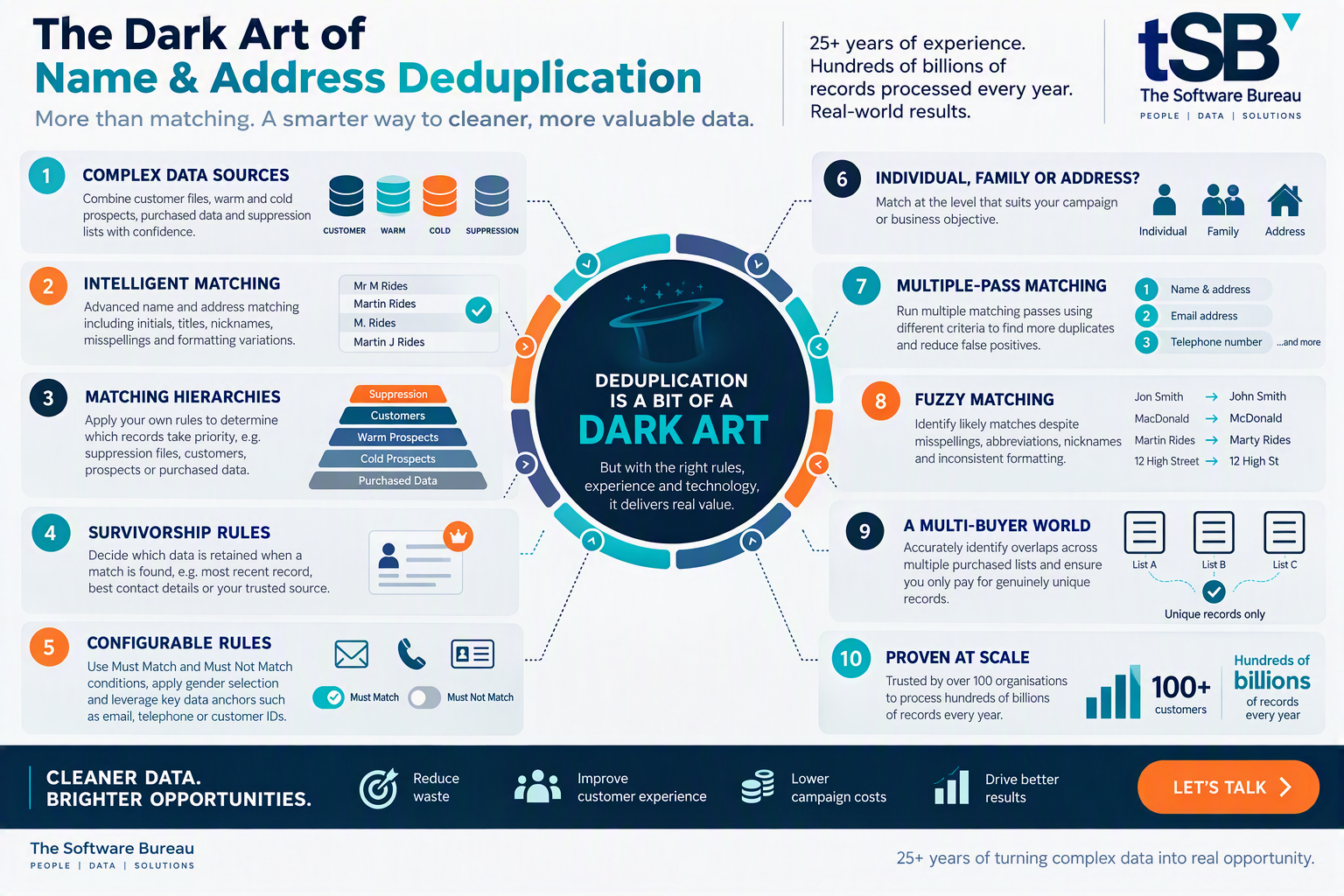
Today, SwiftDedupe helps organisations configure complex matching strategies incorporating individual, family and address-level matching, suppression hierarchies, survivorship rules, fuzzy matching and multi-pass duplicate detection.
We’ve learned one important lesson along the way:
Deduplication isn’t just a technical process. It’s a business process, a commercial process and, sometimes, a dark art.
Not Every Duplicate Is Actually a Duplicate
Most people think of deduplication as finding identical records.
But real-world data rarely behaves that way.
Take a simple example:
- Martin Rides
- Mr Martin Rides
- M Rides
- Martin J Rides
- Mr M. Rides
To a human reader, these could all be the same individual.
To a computer, they’re completely different strings of text.
Now add a change of address, a missing house number, a nickname, a different email address or a typo, and the challenge becomes significantly harder.
The question isn’t simply whether two records look the same.
The question is whether they represent the same person.
And that’s where the real work begins.
The Matching Problem Nobody Sees
Many organisations focus on the matching rules themselves.
What they often overlook is that identifying potential duplicates is only one part of the challenge.
The bigger question is:
What do you do when a match is found?
Imagine you’re preparing a marketing campaign using:
- Existing customers
- Warm prospects
- Cold prospects
- Purchased third-party data
- Internal suppression files
A customer appears on a purchased data file.
Should they be treated as a duplicate?
Almost certainly.
But which record survives?
Should the customer record take priority?
Should the prospect record be discarded?
What happens if the same individual also appears on an internal stop file?
These are not matching decisions.
They’re business decisions.
And every organisation has different priorities.
The Power of Matching Hierarchies
One of the most overlooked elements of successful deduplication is hierarchy management.
A typical hierarchy might prioritise records in the following order:
- Internal suppression files
- Existing customers
- Warm prospects
- Cold prospects
- Purchased data
In this scenario, if an individual exists as both a customer and a prospect, the customer record wins.
A charity may use a different hierarchy.
A retailer may prioritise loyalty customers.
A broker-managed acquisition campaign may apply entirely different commercial rules.
The hierarchy is often just as important as the match itself.
In many cases, it’s where the real value is created.
When a Match Is Found, What Happens Next?
Finding duplicates is only half the challenge.
The next question is often far more important:
Which record survives?
Imagine the same individual appears in:
- An existing customer database
- A purchased prospect file
- A historical campaign file
- A recently updated CRM record
The records match, but the data within them may differ.
Which email address should be retained?
Which telephone number is the most current?
Which version of the name is the most accurate?
This is where survivorship rules become essential.
Sophisticated deduplication solutions don’t simply identify duplicates. They can also determine which data should be retained and which data should be discarded.
For example:
- Retain customer data over prospect data
- Keep the most recently updated record
- Preserve the longest or most complete name
- Retain the highest quality email address
- Prioritise data from the most trusted source
These rules ensure deduplication improves data quality rather than simply reducing record counts.
In many cases, the greatest value comes from creating a richer, more accurate version of the truth.
The Rules Behind the Results
One of the biggest misconceptions about deduplication is that there is a single “correct” answer.
In reality, the best matching strategy depends entirely on what you’re trying to achieve.
Take family matching as an example.
Imagine a family containing:
- Martin Rides
- Michelle Rides
For some campaigns, both records may be retained because each individual is a potential customer.
For others, only one communication should be sent to the family.
What if the campaign is specifically targeted at women?
Suddenly, gender becomes an important part of the matching strategy. Rather than simply suppressing one family member, sophisticated matching software can apply gender-based selection rules to ensure the most appropriate individual is retained.
The same principle applies to data anchors.
Many organisations hold highly trusted data elements such as:
- Email addresses
- Telephone numbers
- Customer reference numbers
- Account identifiers
These can have a significant influence on matching decisions.
In some situations, a field may be configured as a Must Match condition, meaning records can only be considered duplicates if that value agrees.
In others, a Must Not Match rule may be applied, preventing records from matching where a key data element conflicts with the intended business logic.
These controls allow organisations to create highly tailored deduplication strategies that reflect their own operational and commercial requirements.
Individual, Family or Address?
Another fundamental question is:
What exactly are you trying to deduplicate?
Should matching occur at:
- Individual level?
- Family level?
- Address level?
Consider a family living at the same address.
Martin Rides and Michelle Rides could be viewed as:
- Two separate individuals
- One family
- One address
Depending on the objective, each interpretation could be correct.
A utility provider may only require one communication per address.
A retailer may need separate records for each customer.
A charity may apply family-level suppression logic.
A direct mail campaign may choose to retain just one record per address to reduce mailing costs.
There is no universal answer.
Only the answer that delivers the right outcome for the task in hand.
Not All Matching Happens in a Single Pass
One of the biggest challenges in deduplication is that different types of duplicates reveal themselves in different ways.
Some records may match because they share a surname and address.
Others may only be identifiable through an email address or telephone number.
Some may have moved house, changed contact details or contain spelling variations that make straightforward comparisons difficult.
That’s why sophisticated deduplication often involves multiple matching passes, each designed to identify a different type of duplicate.
One pass might focus on:
- Name and address combinations
- Email address matching
- Telephone number matching
- Family-level matching
- Address-level matching
Each pass can uncover duplicates that another matching rule might miss.
This layered approach helps maximise duplicate detection whilst maintaining control over match quality and reducing the risk of false positives.
After all, not every duplicate looks the same.
Fuzzy Matching and the Real World
If all data were perfect, deduplication would be easy.
Unfortunately, real-world databases are full of abbreviations, misspellings, nicknames, typographical errors and inconsistent formatting.
Consider examples such as:
- Jon Smith / John Smith
- MacDonald / McDonald
- Martin Rides / Marty Rides
- 12 High Street / 12 High St
A rigid matching process may treat these as different records.
A sophisticated matching engine recognises that they may represent the same individual.
This is where fuzzy matching techniques become invaluable.
Rather than relying solely on exact character-by-character comparisons, intelligent matching systems consider similarity, probability, phonetics, common variations and contextual information to identify records that are likely to belong together.
Used correctly, fuzzy matching can dramatically improve match rates without sacrificing accuracy.
Used incorrectly, it can create just as many problems as it solves.
That’s why experience matters.
A Multi-Buyer World
Many organisations purchase data from brokers under agreements where they only pay for records that are genuinely unique.
This introduces another layer of complexity.
Let’s say multiple purchased lists contain the same individual.
The deduplication process must accurately identify overlaps whilst ensuring the organisation only pays for genuinely incremental prospects.
Get it right and campaign costs are controlled.
Get it wrong and acquisition costs can quickly spiral.
In these situations, deduplication becomes more than a data quality exercise.
It becomes a commercial necessity.
Experience Matters
Back in 2004, one of our founders, Philip Morgan, delivered a presentation entitled Demystifying Cygnus Dedupe to a captivated customer audience.
Even then, the message was clear.
Successful deduplication depends on far more than comparing names and addresses.
It requires sophisticated logic, intelligent filtering, efficient processing and carefully considered business rules.
More than twenty years later, many of the same challenges still exist today.
The technology has evolved.
The data volumes have exploded.
The principles remain remarkably similar.
The Black Box Magic
People often ask us how our matching engine works.
The honest answer is that there isn’t a single answer.
The logic sitting behind our deduplication tools has been shaped by:
- 25+ years of customer requirements
- Countless matching scenarios
- Hundreds of production environments
- Direct mail campaigns
- Customer databases
- Suppression processing
- Multi-buyer acquisitions
- Family matching projects
- Continuous customer feedback
Every challenge has refined the process.
Every edge case has taught us something new.
Every customer has helped make the software stronger.
The result isn’t simply an algorithm.
It’s decades of practical experience embedded into technology that combines matching hierarchies, family and address-level logic, gender-based selection, data anchors, survivorship rules, fuzzy matching techniques and multi-pass matching strategies.
Our customers don’t process a few thousand records at a time.
They process millions, tens of millions and, collectively, hundreds of billions of records every year.
The matching logic is tested daily by organisations that depend upon accurate results to drive their operations, marketing activities and customer communications.
That level of real-world testing is difficult to replicate in a laboratory environment.
The software has evolved because our customers have evolved.
More Than Matching
At The Software Bureau, we’ve learned that successful deduplication isn’t about finding duplicates.
It’s about understanding business rules.
Whether that’s customer hierarchies, family matching, gender-based selection, suppression strategies, data-anchor logic, survivorship rules, fuzzy matching techniques or configurable Must Match and Must Not Match conditions, every organisation views its data differently.
The challenge is building a matching strategy that reflects those objectives while remaining accurate, scalable and repeatable.
To many people, deduplication looks like a black box.
To us, it’s simply what we’ve been doing for more than 25 years.
Because effective deduplication isn’t just about matching names and addresses.
It’s about understanding people, families, organisations and business objectives.
That’s why it remains one of data management’s true dark arts.
And why organisations continue to trust The Software Bureau to get it right.
Want to Learn More?
Whether you’re managing customer databases, prospect files, suppression lists, purchased data or complex multi-source marketing campaigns, The Software Bureau’s deduplication solutions have been helping organisations solve challenging matching problems for more than 25 years.
If you’d like to discuss your matching requirements, hierarchy rules, survivorship strategies, suppression processes or wider data quality challenges, get in touch with the team.
We’ve probably seen it before. And if we haven’t, we’d love the challenge.