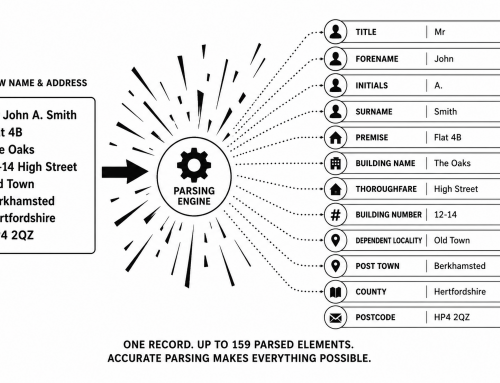
As a Data Manager, few things are as satisfying as a well-structured, consistent, and universally adopted dataset. In the UK, the postcode system is a prime example of this data harmony. It is more than just a sequence of letters and numbers; it is a critical piece of infrastructure, a tool for logistics, planning, and analysis. But how did this essential system evolve into the sophisticated data structure we use today?
The Early Days: Before the Code
Before the systematised codes, postal workers relied on geographical knowledge and local sorting districts. The first step toward standardisation came in the mid-19th century.
- 1857: London was divided into 10 postal districts (E.C., W.C., N., S.W., etc.), which were essentially the predecessors to our current postcodes. This move was crucial as it recognised the need to group addresses for more efficient routing.
- The Post Office’s Focus: The primary concern was internal efficiency: making sure mail moved faster within their own network. The codes were a tool for the sorters, not necessarily for the public.
The Postcode Revolution: A National Standard
The real shift began in the 20th century, driven by an explosion in mail volume and the growing need for mechanisation and automation.
- 1959: The first trial of the new postcode system began in Norwich. This trial was a massive data-gathering and implementation exercise, setting the stage for national rollout.
- 1966 – 1974: The national implementation was a monumental task, carried out by the General Post Office (GPO), later the Royal Mail. This involved assigning a unique code to nearly every addressable location in the country.
- Data Structure: The final codes were designed to be alpha-numeric and hierarchical, enabling both machine and human readability.
This two-part structure (separated by a space) is the genius from a data perspective: it allows for drill-down analysis and ensures efficiency at both the national and local levels.

Beyond Mail: The Postcode as a Data Key
Today, the postcode is the bedrock of countless business and governmental data systems, functioning as a powerful geographical data key.
- Location Services: It allows for quick geocoding (translating an address to geographical coordinates) and is fundamental for mapping and navigation.
- Market Analysis: Businesses use postcodes for catchment area analysis, retail planning, and targeted marketing campaigns, as they often correlate strongly with demographics.
- Emergency Services: Postcodes are a vital component of dispatch systems, enabling rapid location identification.
In short, the postcode is the ultimate data aggregator, a concise, universally understood identifier that links disparate datasets.
The Data Manager’s Caution: Postcode is Not an Address
Now for the crucial caveat: a detail that every Data Manager and Logistics Planner knows: a postcode alone is never enough for delivery.
While a postcode like SW1A 0AA points you to The Houses of Parliament, it does not specify which door, which department, or which person.
- The Problem: The smallest unit of a postcode (the postcode sector, e.g., SW1A 0) can cover anywhere from a handful to hundreds of individual delivery points. The full postcode (e.g., SW1A 0AA) typically covers about 15 individual addresses.
- The Delivery Requirement: For a parcel to arrive correctly, you need the full address: the street name, house number or name, and often the town/city. This ensures the delivery driver can match the item to a unique delivery point.
Postcode delivers to a zone; the full address delivers to the door.
Navigating Address Complexity
For data managers, UK addresses present a unique challenge beyond the simple postcode to door distinction. The lack of strict national standardisation means we often encounter complexities such as non-sequential street numbering, the prevalent use of house names instead of or alongside numbers, and variations in administrative boundaries like counties. Furthermore, addresses sometimes contain multiple occupation points or rely on older, less formal conventions. This lack of uniformity necessitates sophisticated validation and cleaning processes, such as matching against the official Postcode Address File (PAF), to ensure a high level of data accuracy. Without these efforts, systems struggle to reliably assign attributes or deliver goods, turning a seemingly simple address field into a complex data validation task.
For any Data Manager, this distinction is key: the postcode is a routing variable, but the full address is the unique identifier needed for the final physical operation. Relying only on a postcode in a logistical system is a guaranteed path to failure and frustrated customers.
The UK postcode system is an exemplary piece of national data infrastructure. Its history is a testament to successful long-term planning, and its current use proves its enduring value, as long as we remember its purpose is to direct, not to complete the journey on its own.