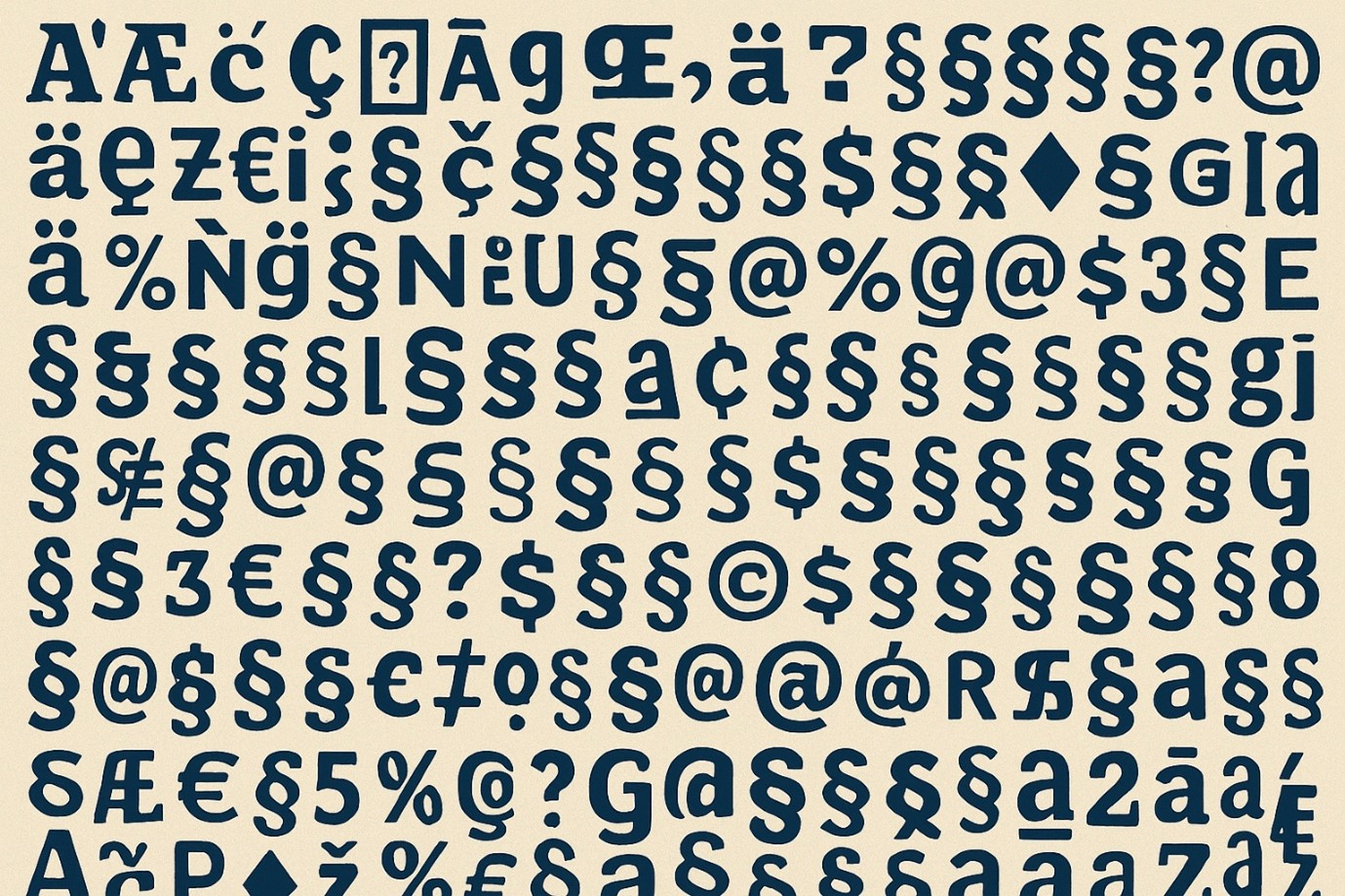
Text corruption has long been one of the most frustrating obstacles in data processing. Anyone who has worked with large, diverse data sources will have encountered the odd tangle of characters that appear in place of clean text. This problem, known as Mojibake, arises when character encoding is misinterpreted. It looks like a small nuisance on the surface, but in practice it can disrupt analytics, weaken matching, and undermine entire workflows.
To address this, we have introduced a translation fix within our SwiftCore processing engine. It is designed to prevent Mojibake at source, repair corrupt text when encountered, and improve the overall integrity of every dataset that passes through the platform.
What causes Mojibake in the first place?
Mojibake is the result of a mismatch between how text is stored and how software interprets the underlying bytes. If data that was originally saved in UTF-8 is read as Windows-1252, for example, the output will be garbled. This often happens when:
- Data arrives from multiple upstream systems, each with its own encoding standards.
- File metadata does not correctly specify encoding.
- Legacy environments feed into modern pipelines.
- Text is accidentally double-encoded or double-decoded.
These small errors can propagate, especially in automated data flows, creating larger inconsistencies further down the line.
A real example of Mojibake in customer data
Encoding issues are particularly visible in name and address data. Below is a realistic example of how a common European name and standard UK address can appear when corrupted, followed by the corrected version after applying the new SwiftCore translation fix.
Before (corrupted)
Mr Jürgen Höfner
17A Quørnley Road
Wólverstone
Süffolk
IP10 2HT
After (corrected)
Mr Jürgen Höfner
17A Quornley Road
Wolverstone
Suffolk
IP10 2HT
This type of corruption can break matching, distort customer records and increase manual work. By automatically detecting and repairing these errors, SwiftCore ensures that data is interpreted and stored correctly throughout the pipeline.
How SwiftCore now prevents Mojibake
Our new translation fix enhances SwiftCore’s handling of incoming text by introducing three key improvements.
1. Automatic encoding detection
SwiftCore now analyses byte patterns to identify the most likely source encoding. Rather than assuming a default, it evaluates common encodings such as UTF-8, UTF-16, Windows code pages and various legacy formats. This reduces the chances of misinterpretation from the outset.
2. Intelligent normalisation
Once the correct encoding is identified, SwiftCore converts the text into a consistent internal encoding format. This ensures that every subsequent stage of the pipeline works with clean, uniform data.
3. Safe recovery of corrupted segments
Where Mojibake has already occurred before ingestion, SwiftCore applies a controlled recovery process that reinterprets the damaged text and restores it wherever possible. This approach salvages content that might otherwise require manual correction or be lost entirely.
Why this matters
Data integrity is fundamental to accurate analytics, reliable decision-making and effective customer engagement. Encoding issues may be subtle, but they can influence everything from campaign personalisation to identity resolution. By eliminating Mojibake at scale:
- Matching and linking scores improve.
- Downstream systems receive cleaner and more consistent data.
- Manual correction time is significantly reduced.
- The overall quality of insights increases.
It also means organisations can ingest a broader variety of data sources with greater confidence.
What this means for SwiftCore users
You will not need to adjust your workflows. The translation fix operates automatically within the engine. Wherever your data comes from, SwiftCore will apply the appropriate interpretation, normalise the content, and strengthen the consistency of the final output.
This enhancement supports our continued focus on improving data quality, performance and resilience across all parts of the processing engine.