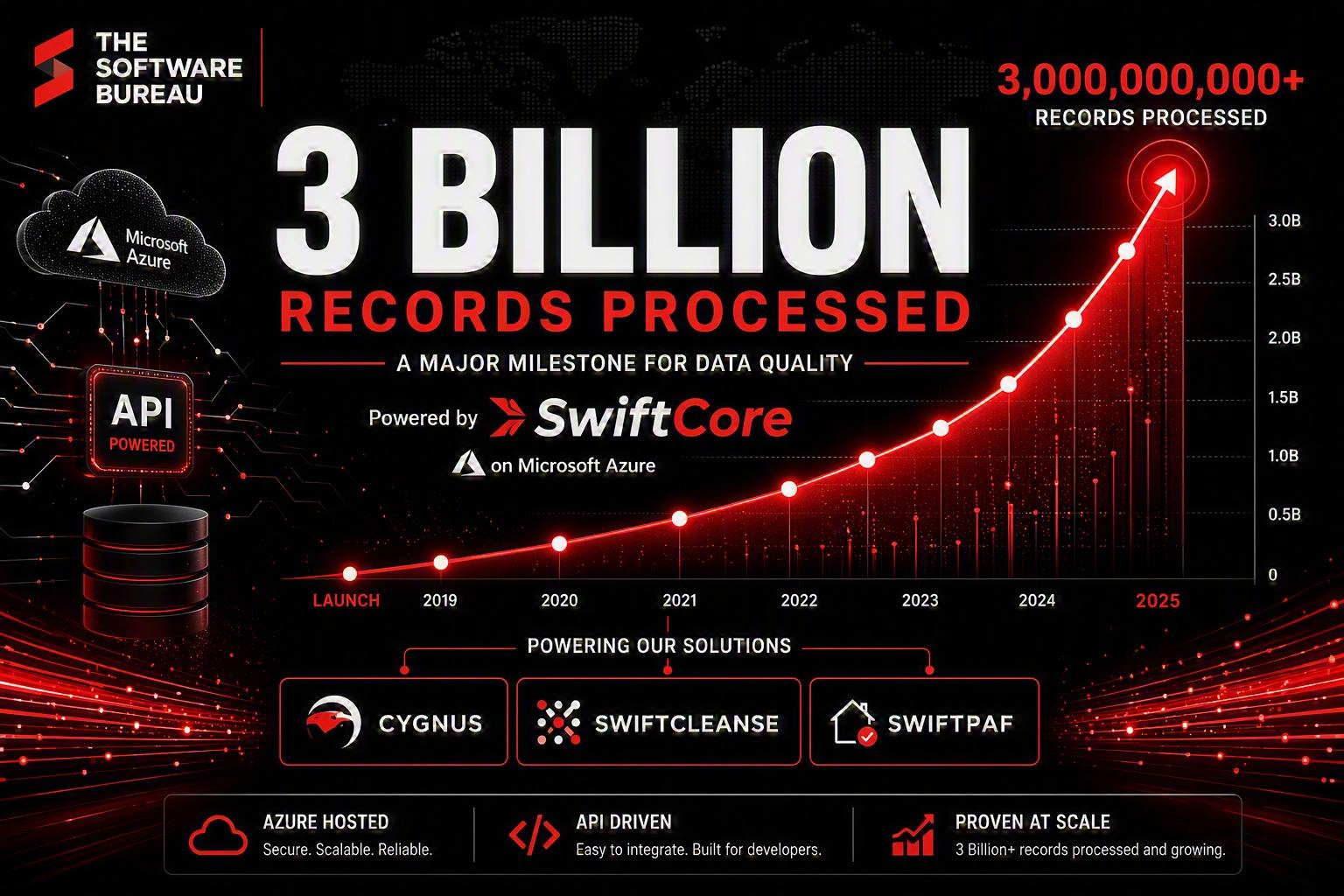
Celebrating a Major Milestone: 2 Billion Records Processed Through Our Cloud PAF Engine

By |2026-03-30T10:17:23+00:00March 30th, 2026|

We have reached an important moment in our journey. Our cloud PAF engine has now processed more than 2 billion records since launch. It is a milestone that speaks to the strength of our technology, the ambition behind our platform strategy, and the trust our clients place in us every day. This achievement is not just about volume. It is a demonstration of the speed, reliability and scalability that sit at the heart of our data processing architecture. SwiftPAF Joins the SwiftCore Ecosystem The phased roll out of our centralised PAF processing has taken another major step forward. Earlier this month, our SwiftPAF application was successfully connected to SwiftCore, marking a key moment in the evolution of our processing framework. [...]

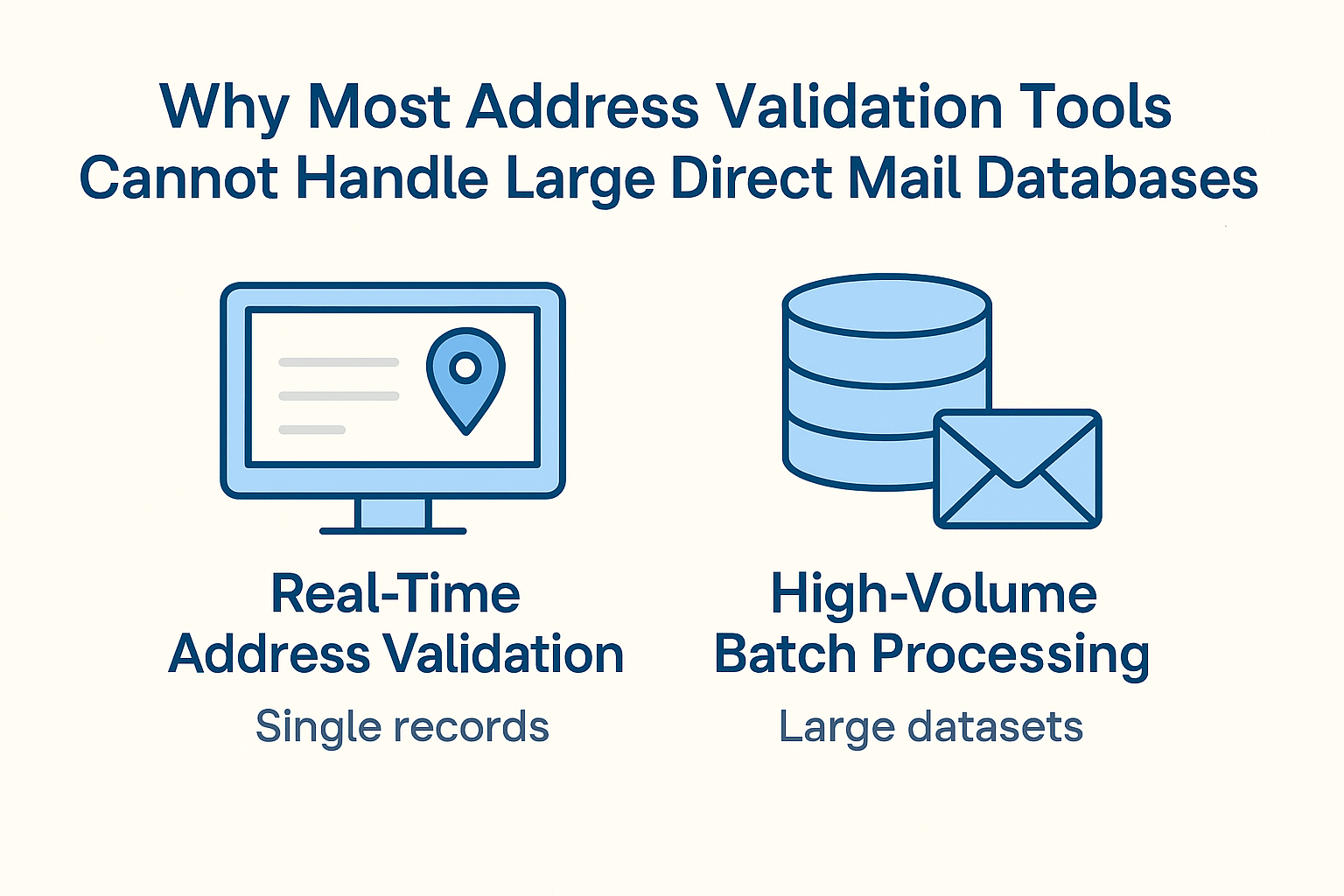
Why Most Address Validation Tools Cannot Handle Large Direct Mail Databases

By |2026-03-11T11:45:42+00:00March 11th, 2026|

In data marketing, scale determines everything. Validating a single address on a web form is fundamentally different from processing tens or hundreds of millions of customer records for a direct mail campaign. Many organisations assume that the same address validation tools can support both scenarios. They cannot. The gap between real-time address validation and industrial-scale batch processing is significant. Misunderstanding that difference often results in long processing times, inefficient workflows and delays in direct mail production. This article explains why large-scale data processing requires specialist software and how The Software Bureau supports these high-volume environments. Real-Time Address Validation vs High-Volume Batch Processing Most modern address validation services are designed for real-time usage. A typical example is a consumer entering an [...]

Understanding the Mailing Preference Service: What It Is (and When You Need It)

By |2025-11-12T13:47:06+00:00November 12th, 2025|

The Mailing Preference Service (MPS) is one of the most important suppression files in UK direct mail. Managed by the Data & Marketing Association (DMA), MPS allows consumers to opt out of receiving unsolicited mail, that is, marketing they did not ask for and from companies they have no existing relationship with. In short, if you are sending cold mailings, the MPS is your best friend. It protects consumers’ preferences and keeps you compliant with best practice and data protection principles. When You Need to Use MPS Any business using third-party or prospect data for direct mail campaigns must screen against the MPS before mailing. This ensures that anyone who has opted out of receiving unsolicited marketing is removed from [...]

Revolutionising UK Mail Sortation with USE, the Engine Behind Cygnus & SwiftSort

By |2025-10-28T06:59:54+00:00November 3rd, 2025|

For over 25 years, The Software Bureau has been at the forefront of data processing and postal sortation in the UK. Our commitment to innovation and accuracy has helped over 100 clients, ranging from direct mail producers to charities and corporates, navigate the ever-evolving complexities of bulk mail sortation. At the heart of our sortation ecosystem lies USE, the Universal Sortation Engine, a powerful on-premise API that drives our flagship products, Cygnus and SwiftSort. What is USE? USE is our Postal Sortation API, designed to automate and integrate the sortation of UK mail in compliance with all major postal service operators, including: Royal Mail UK Mail Whistl Citipost The Delivery Group Whether you're sorting for Mailmark, Zonal, or Unsorted services, [...]

Why Keeping Contact Data Up to Date Is Business-Critical

By |2025-08-18T14:39:17+00:00August 18th, 2025|

When it comes to customer data, accuracy isn’t a “nice to have” — it’s the difference between reaching your audience and wasting money. Out-of-date or inaccurate contact data drives up costs, damages customer relationships, and makes your organisation look sloppy. Let’s put it into perspective: last month alone, Royal Mail made 57,442 changes to the Postcode Address File (PAF). That’s not an annual figure, that’s a monthly update. Streets get renamed, new addresses are added, businesses move, people relocate — and the PAF is constantly shifting to reflect this. If your database isn’t keeping pace, you’re already behind. There’s really no excuse for poor address management anymore. The tools are out there, and they’re not just good — they’re automated, [...]

Handling Half a Billion Records: The Power Behind Our Data Cleansing Engine

By |2025-08-04T11:44:09+00:00August 4th, 2025|

When it comes to data cleansing, volume matters. But so does variety, speed, security, and, above all, accuracy. At The Software Bureau, we manage a portfolio of suppression and home mover data so vast that it clocks in at around 500 million records—and growing. Every single one of these records comes from a trusted, vetted source, gets cleaned and enhanced, and is then deployed to our clients through our on-premise and cloud applications—quickly, securely, and without fuss. The Data Powerhouse Our centralised database is fed by some of the most respected and widely used data providers in the UK, including: Experian – Mortality, Absolute Contacts, Movers Sagacity – TBR, GAS, GASReactive MiExact – Mortascreen, NDR, Fression Royal Mail – BCF, [...]

Partially Addressed Mail: The Secret Source of Responsive Acquisition Data

By |2019-01-15T09:58:03+00:00January 15th, 2019|

As we all know, last year GDPR made it illegal for marketers to contact cold prospects where legitimate consent could not be proven. Brands who previously relied upon sending mail to bought-in lists in order to acquire customers were forced to dramatically rethink their marketing strategy. Some reverted to untargeted, less responsive door drops, others redirected their marketing spend to other communication channels entirely for fear of prosecution by the ICO. However on October 5th 2018 Royal Mail sent a letter to customers titled Trial of a new advertising mail service: Royal Mail Partially Addressed Mail™. The letter introduces Partially Addressed Mail as a new way to identify and communicate with prospects. The product promises 165x greater targeting than door [...]

5 Ways Cygnus can Help with GDPR

By |2018-11-06T10:39:16+00:00December 13th, 2017|

As 2017 ebbs away and the countdown to May 2018 and GDPR enforcement creeps closer we thought we would share just some of the ways Cygnus can be used to meet GDPR requirements. Here are 5 ways Cygnus users can demonstrate GDPR credentials to data controllers.   1. Help Data Controllers Implement Information Audit Outcomes Many months ago The ICO published Preparing for GDPR – 12 steps to take now. This guide is a commonly used reference guide to achieving GDPR compliance. After the obvious first step ‘make people aware of GDPR’ the second recommendation is to conduct a data audit. You should document what personal data you hold, where it came from and who you share it with. You [...]

Lean DM – Focus On Error Reduction and Increased Revenues

By |2016-12-28T14:26:33+00:00September 6th, 2016|

We can all recount those horrible moments when we realise a mailing has gone wrong. If you are lucky the job hasn’t left the building, but invariably the first you know about it is when you receive that dreaded, irate call from the client. Then comes that sickening feeling while you retrace the steps of the job only to find the error occurred in data preparation. During a particularly high pressure week, one of the data processing team accidentally sorted the surname column of a data file independently of the other columns and every mailer was sent with an incorrect surname. With many mail producers these high impact errors can have huge financial consequences and cripple the reputation of the [...]

Five reasons why an in-house data processing tool is a must for fulfilment houses

By |2017-01-12T13:04:15+00:00June 18th, 2016|

Direct Mail’s star is in ascendance. Stats and recent research show that volumes are on the increase. End users are becoming increasingly aware of the power of DM as a legitimate marketing tool as new initiatives from organisations such as Royal Mail are widely publicised. Moreover, as criticisms continue to be levied against telemarketing, lead generation and internet display advertising budget is being shifted across to DM from new and existing mail clients. This is obviously great news for those of us in the industry. But with it comes responsibility – and that responsibility is in the form of exemplary data hygiene. Get it wrong and we risk damaging the reputation of an already fragile (but recovering) medium. All of [...]

Go to Top