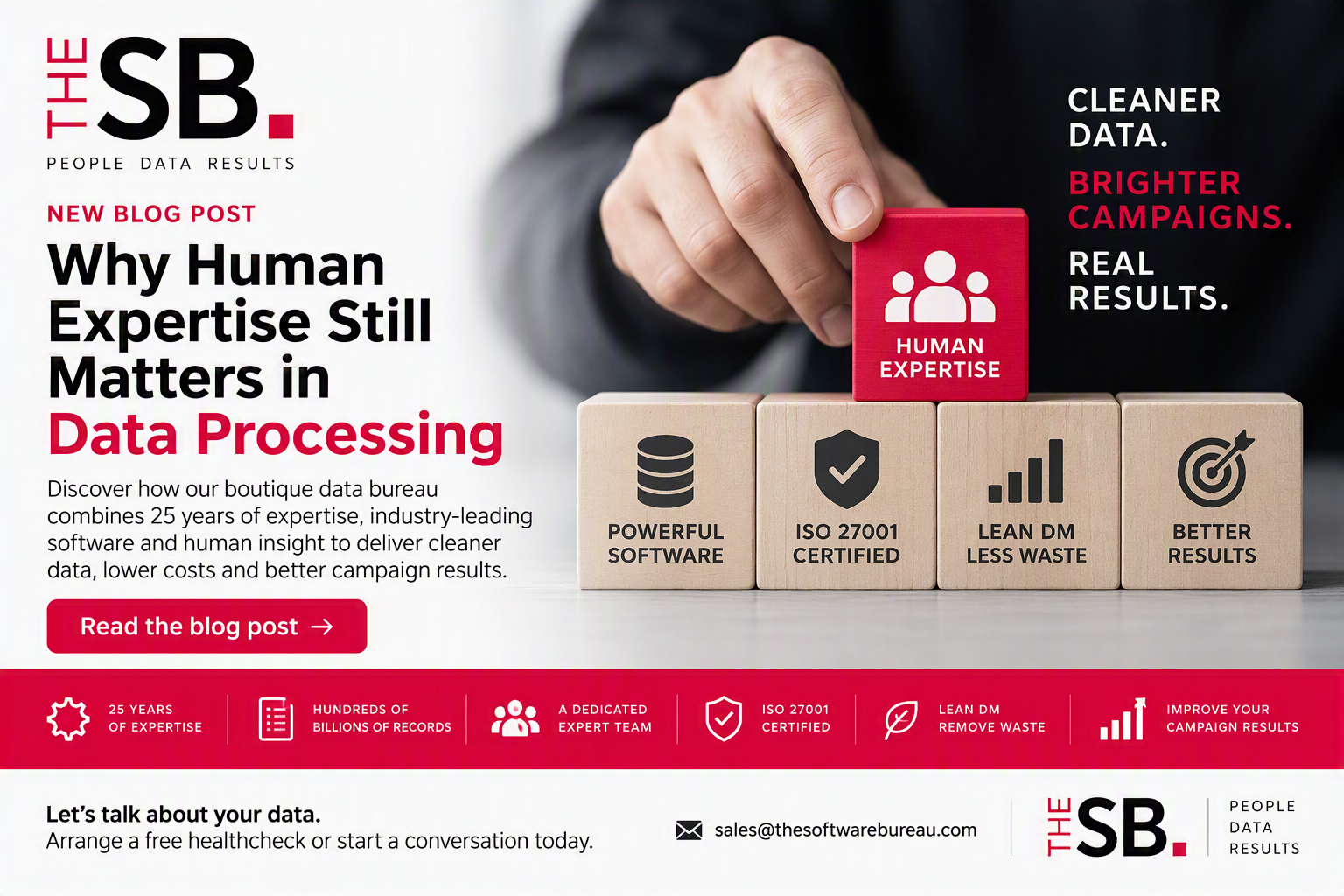
Why Human Expertise Still Matters in Data Processing

By |2026-10-14T11:22:03+00:00October 14th, 2026|

In a world increasingly driven by automation, APIs and self-service platforms, it's easy to assume that data processing has become a commodity. Upload a file, press a button, and let the software do the work. The reality is very different. Data quality remains one of the biggest challenges facing organisations today. Customer data is often collected from multiple sources, stored in different formats, and maintained by different teams over many years. Every dataset has its own quirks, inconsistencies and hidden issues. That is why experience, expertise and human insight still play a critical role in achieving the best possible outcomes. At The Software Bureau, we've built a boutique data bureau service that combines industry-leading software with something far more valuable: [...]

One Customer, One Golden Record: What Chums Can Teach Us About Customer Data Quality

By |2026-10-07T13:47:39+00:00October 7th, 2026|

For many retailers, the challenge isn't attracting customers. It's maintaining an accurate view of them. Today's customers engage through multiple channels. They browse online, call customer service teams, respond to marketing campaigns and, in some sectors, still place orders through traditional mail. Every interaction creates data and every new piece of data introduces the potential for duplication, inconsistency and error. Our latest customer story with Chums demonstrates exactly why customer data quality remains so important and how a well-designed data management strategy can improve accuracy, reduce costs and protect brand reputation. The Challenge: Many Channels, One Customer Since 1981, Chums has built a successful home shopping business serving customers across the UK. While around half of its business now comes [...]

You Can’t Match What You Can’t Understand: Why Name & Address Parsing Is the Bedrock of Data Processing

By |2026-08-24T11:08:55+00:00August 24th, 2026|

There is a part of the data processing world that rarely gets the attention it deserves. It isn't glamorous. It doesn't generate exciting dashboards. It probably won't feature prominently in an AI strategy presentation. But get it wrong and virtually everything that follows can go wrong. Name and address parsing. At The Software Bureau, we believe accurate parsing is the bedrock of batch data processing. Whether the objective is address matching, deduplication, sorting, indexing, suppression, enrichment or the creation of a Single Customer View (SCV), it all starts with understanding exactly what is contained within a name and address record. And that is considerably more complicated than it sounds. What exactly is parsing? At its simplest, parsing is the process [...]

It was supposed to be a one-day job

By |2026-08-11T11:17:54+00:00August 11th, 2026|

When the deadline is set in stone and the brief keeps growing, the right data processing software can be the difference between meeting the deadline and winning the next job, or missing it and losing the client. I was catching up with John Knight, who runs a data bureau called DPS Direct, and has been using Cygnus for over 20 years. Anyone in this corner of the industry knows the feeling. Print has a date, the mailing has a date, the schedule gets squeezed at both ends, and the data is always the last piece to drop into place. When it slips, or the brief changes at the eleventh hour, it is the data team left to pull it out [...]

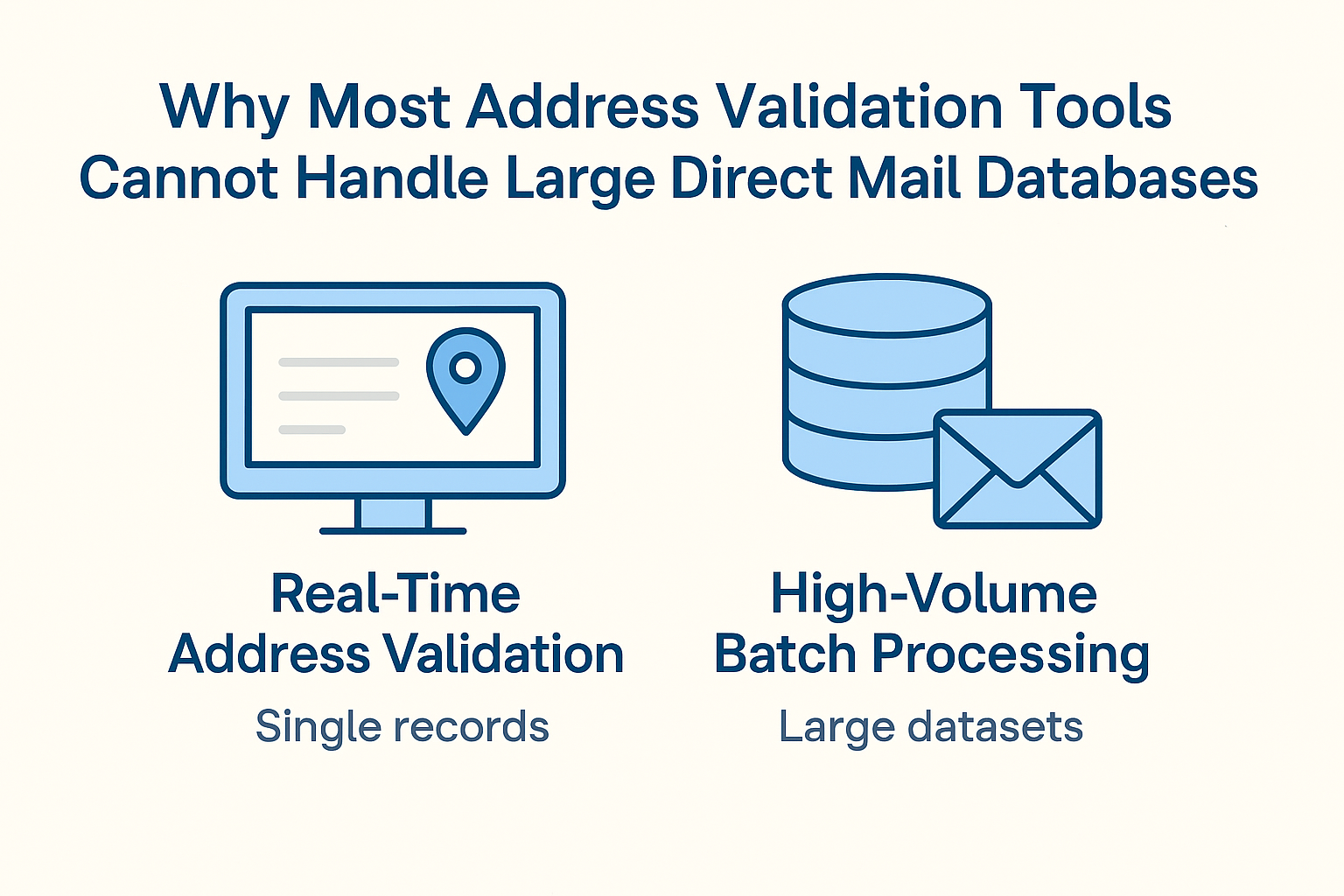
Why Most Address Validation Tools Cannot Handle Large Direct Mail Databases

By |2026-03-11T11:45:42+00:00March 11th, 2026|

In data marketing, scale determines everything. Validating a single address on a web form is fundamentally different from processing tens or hundreds of millions of customer records for a direct mail campaign. Many organisations assume that the same address validation tools can support both scenarios. They cannot. The gap between real-time address validation and industrial-scale batch processing is significant. Misunderstanding that difference often results in long processing times, inefficient workflows and delays in direct mail production. This article explains why large-scale data processing requires specialist software and how The Software Bureau supports these high-volume environments. Real-Time Address Validation vs High-Volume Batch Processing Most modern address validation services are designed for real-time usage. A typical example is a consumer entering an [...]

Why Processing Customer Data Against Change of Address Files is Crucial for Business Success

By |2026-01-14T12:45:08+00:00January 14th, 2026|

Every year, UK businesses waste £1 billion on mistargeted mailings: sending communications to people who have moved or even passed away. Beyond the financial cost, this erodes brand reputation and risks GDPR non-compliance. With 3.5 million households moving annually and 548,000 deaths each year, customer data decays at an alarming rate. This is why processing your data against Change of Address (COA) datasets is not just best practice; it is essential. What Are COA Data Sets? Change of Address files, such as Royal Mail’s National Change of Address (NCOA) and Experian’s Absolute Contacts, identify when a person has moved and provide their new address. These datasets allow businesses to: Suppress goneaways (people who have moved and not informed you). Update [...]

Partially Addressed Mail: The Secret Source of Responsive Acquisition Data

By |2019-01-15T09:58:03+00:00January 15th, 2019|

As we all know, last year GDPR made it illegal for marketers to contact cold prospects where legitimate consent could not be proven. Brands who previously relied upon sending mail to bought-in lists in order to acquire customers were forced to dramatically rethink their marketing strategy. Some reverted to untargeted, less responsive door drops, others redirected their marketing spend to other communication channels entirely for fear of prosecution by the ICO. However on October 5th 2018 Royal Mail sent a letter to customers titled Trial of a new advertising mail service: Royal Mail Partially Addressed Mail™. The letter introduces Partially Addressed Mail as a new way to identify and communicate with prospects. The product promises 165x greater targeting than door [...]

Introducing SwiftCore – Cloud Data Processing

By |2018-11-06T10:39:44+00:00December 1st, 2017|

“What if we could take everything our Cygnus clients love about Embedded Suppression. All the files in one place, control over the sequence of matches, no negotiations with individual file owners. And make it all available to developers in the cloud?” It’s November 2016 and the product team at The Software Bureau are meeting to discuss the roadmap for Swift and Cygnus. An unprecedented silence falls upon the room while everyone reflects on Andy Benson’s challenge. Seconds later and the room has erupted into a frenzy of noise and excitement. Developers are frantically drawing system diagrams on the white board and talking about Azure Cloud, Serverless tech, Planet Scale processing, data chunking and NoSQL databases. The commercial team are contemplating [...]

Lean DM in the Press – The Print Business

By |2016-12-28T13:36:31+00:00October 25th, 2016|

Gareth Ward, Editor of Print Business magazine visited The Software Bureau last month. The conversation quickly turned to Lean DM and the mission to eradicate waste from direct mail campaigns. Gareth was keen to learn how print businesses and mail producers are profiting from bringing their data services front of house. Click here to read the article from Print Business magazine. Download your copy here Free Introduction to Lean DM To learn more about Lean DM why not download your free 30-page guide. Should you wish to arrange a demonstration of Cygnus or undertake a free trial, please contact us.

Lean DM – Focus on Intelligent Deduplication

By |2017-01-11T22:08:27+00:00August 17th, 2016|

On occasion we have all received the same piece of mail multiple times. Maybe we signed up to a service twice or made two frequent purchases from a website or donated to a charity over the phone and also by post. Regardless of the reason, it feels like a waste and as a consumer you know somewhere down the line you are paying for that waste. Failure to effectively remove duplicates from a mailing file can also have greater consequences. One high profile charity donor received more than 10 duplicate appeal packs and immediately and publicly withdrew their support for the charity. His viewpoint ‘you obviously don’t need my support if you can afford to waste money sending me all [...]

Go to Top