
CUSTOMER STORY • CHARITY
Suppression that pays for itself eight times over
How Age UK brought data cleansing in-house on Cygnus and stopped around a million pounds a year of mail reaching supporters who had moved or passed away.
Bringing it in-house stopped a million pounds of mail that should never have been sent
Age UK is the country’s largest charity dedicated to helping people make the most of later life, and its supporter base reflects that. Keeping those supporter records accurate matters more here than in most organisations, and it matters for reasons that go well beyond postage.
Rather than send the data out to a bureau, Age UK reviewed the options and brought the entire process in-house using Cygnus. Today the charity cleanses up to 1.5 million supporter records a quarter, suppresses around 800,000 goneaway and deceased records a year and avoids more than £1 million of mail that would otherwise have gone to people who had moved or passed away.
The story in brief
THE CHALLENGE
Keeping a supporter database accurate is a duty of care
Age UK’s supporters are older than most charities’, so records go out of date more quickly: people move in with family or into care, and people pass away. Writing to someone who has moved wastes money the charity would far rather spend on its work. Writing to someone who has passed away causes real upset to the family left behind and does lasting damage to how the charity is seen. Keeping the database up to date, with accurate addresses, free of duplicates and those who have moved or passed away, was never routine housekeeping. It was part of the duty of care Age UK owes its supporters, and it needed to be done to a very high standard, accurately and cost-effectively.

“The decision to bring our data cleansing and processing in-house using Cygnus has been of enormous benefit to the charity.”
Claudio Deriu, Data Specialist, Age UK
THE SOLUTION
Everything the charity needed, in one piece of software
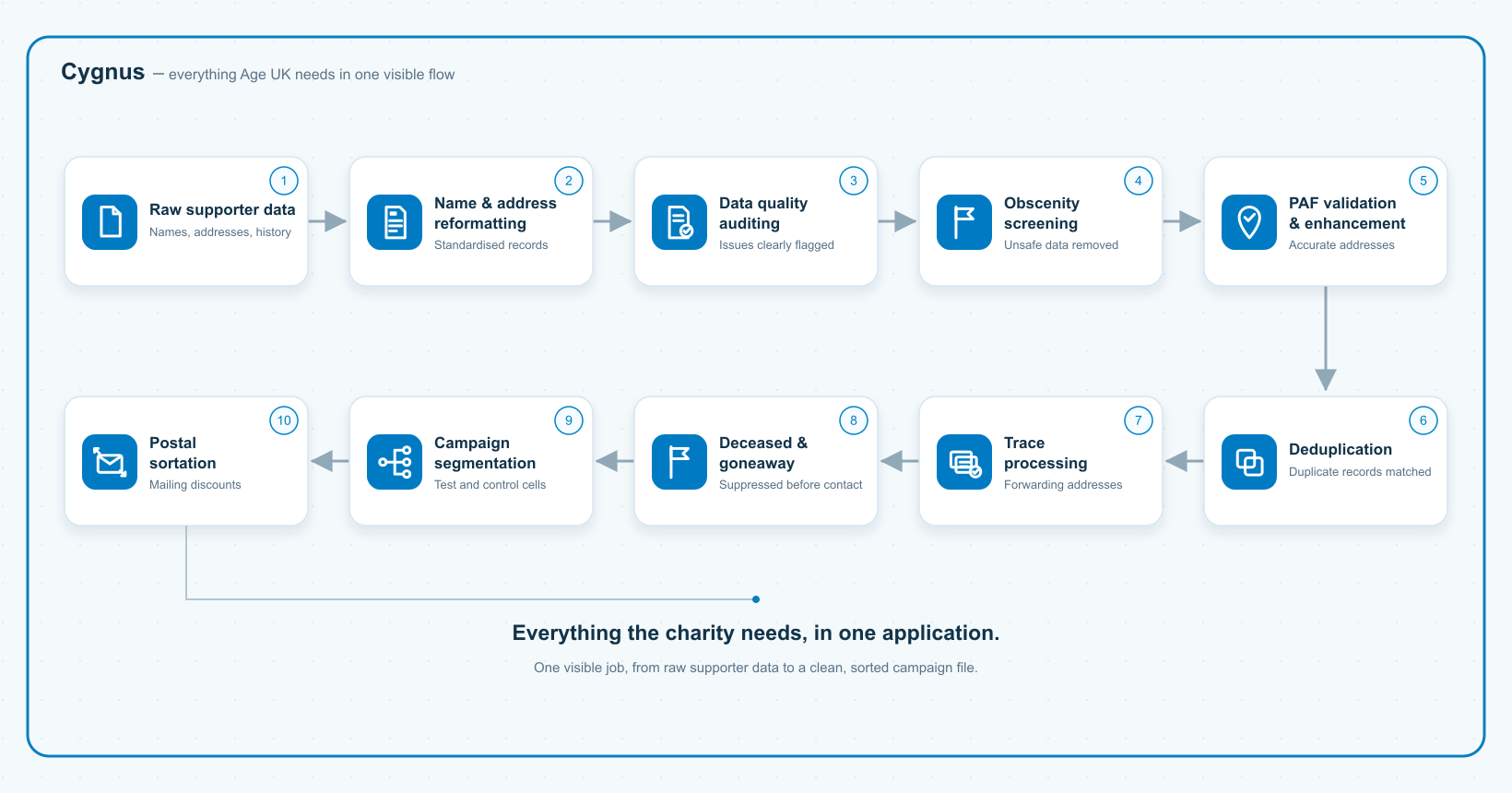
Age UK researched what was available and chose Cygnus. The software is driven through a visual interface that lays each step of a job out clearly, so the data team can see exactly what is being done to the file and check it as they go.
The functionality the charity needed came to a long list:
- Name and address reformatting
- Data quality auditing
- Obscenity screening
- PAF validation and enhancement
- Deduplication
- Trace processing for forwarding addresses
- Deceased and goneaway screening
- Data segmentation for campaign work
- Postal sortation for mailing discounts
Being able to source all of that from one application, rather than assemble it from several suppliers, was the deciding factor.
01
Standardise and validate the file
Names and addresses are reformatted into a consistent structure and the file is audited so the team can see its condition. Obscenity screening catches anything dangerous early in the process and PAF validation corrects and completes every address so it is accurate and attracts the highest discounts for mailing.
02
Remove the records that should not be mailed
Deduplication finds supporters recorded more than once. Screening against embedded goneaway, home mover and deceased files removes anyone who has moved or passed away and trace processing picks up forwarding addresses for supporters the charity wants to stay in touch with. Cygnus carries over 450 million suppression records, so the file is screened as part of the process without needing third party suppliers.
03
Build and sort the campaign
The same cleansed file is then segmented for campaign work, including test and control cells and sorted for the appropriate postal discount scheme. Because the suppression and PAF work has already been done inside Cygnus, the charity can also take advantage of further savings such as sustainable advertising mail and barcoded mail, without the file having to be processed in multiple steps with different suppliers.
IN PRACTICE
What it saves
In a single year Age UK suppressed just over 800,000 records. At the pack price of the time, mailing those records once would have cost around £400,000. Supporters are mailed three or four times a year, so across a full year that is more than £1 million spent reaching people who had moved or passed away.
The suppression returned around eight times what it cost, and that is before counting the upset avoided.
Keeping the work in-house matters as much as the software. Sending data out to a bureau costs a fee to clean it and a royalty on every match found against the goneaway and deceased files. It also takes time, and by the time a file has come back and travelled on to the mail production facility it is already out of date.
Speed was another key factor. A cleanse of a million records runs in about two hours. When a campaign is needed quickly, the data can be segmented, sorted and with the production facility in an hour or two rather than days.
1M records cleansed in ~2 hours · campaign data out in an hour or two · £120K spent against £1M+ avoided
“A clean database prevents inappropriate communication, which is both costly and damaging to the charity.”
Claudio Deriu, Data Specialist, Age UK
Why it matters for other charities
Bringing data hygiene in-house provides a host of benefits.
Control of the data
Supporter records stay with the charity. There is no round trip to a third party so GDPR risks are avoided.
Savings that fund the work
Measured against the mail it prevents, processing and hygiene work returns several times what it costs and that money goes back into the charity’s work.
Quality the team can see
An in-house team that knows its own data can check, review and maintain quality through the reports Cygnus produces at each step, rather than taking a supplier’s word for it.
Care for supporters and their families
Confidence in data quality means not writing to someone who has passed away and not causing upset to the family who are still there.